Composer
Carl Maria von Weber
The father of German Romantic opera, from haunted forests to fairy kingdoms.
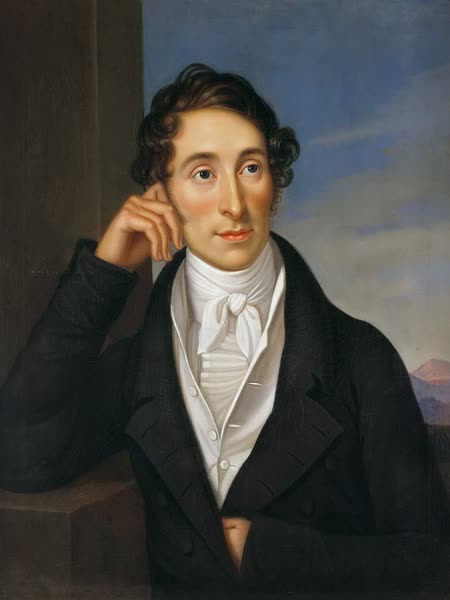
Carl Maria von Weber created German Romantic opera. His Der Freischütz (1821), full of folk songs, hunting horns, dark forests, and the supernatural, gave Germany an opera that felt truly its own, and it set the scene for Wagner. He was also a brilliant pianist and conductor, and his concertos for clarinet are still among the best ever written.
Life in brief
Weber was born in 1786 in Eutin, in northern Germany. His father ran a traveling theatre company, so he grew up on the road, surrounded by actors, singers, and stagecraft. His cousin Constanze had married Mozart, and his father hoped Carl would become another child prodigy. He studied with Michael Haydn, the younger brother of Joseph Haydn, and wrote his first opera as a teenager.
At seventeen he became music director of the theatre in Breslau, and over the next years worked in Stuttgart, Prague, and other cities, sometimes in trouble: in Stuttgart he was briefly arrested over his father's debts and banished. In 1817 he became director of the German opera in Dresden, where he fought to establish opera in German against the fashion for Italian works.
Der Freischütz, premiered in Berlin in 1821, was a sensation, and its tunes were soon whistled across Germany. Already ill with tuberculosis, he wrote Euryanthe for Vienna and then Oberon for London, where he went to conduct its premiere in 1826. He died there two months later, aged thirty-nine. Eighteen years afterwards his remains were brought home to Dresden, with Wagner giving the funeral oration.
Music and style
Weber's music is colorful, dramatic, and atmospheric. He was a pioneer of orchestral color, using instruments for mood: dark, mysterious clarinets, ghostly string tremolos, hunting horns, and eerie low flutes. He drew on folk song and the German landscape, and he loved the supernatural and the fantastic. As a conductor, he was one of the first to rehearse and direct an opera with a modern conductor's authority.
Key works
- Der Freischütz (1821) - a young hunter makes a pact with dark powers for magic bullets; its terrifying "Wolf's Glen" scene and rousing Huntsmen's Chorus are famous. See opera.
- Invitation to the Dance (1819) - a piano rondo that is an early concert waltz, later orchestrated by Berlioz. See waltz.
- Clarinet Concertos Nos. 1 and 2 (1811) - written for his friend, the virtuoso Heinrich Baermann. See clarinet.
- Oberon (1826) - a fairy-tale opera whose magical overture, opening with a solo horn call, is a concert favorite.
- Konzertstück in F minor (1821) - a dramatic one-movement piece for piano and orchestra that tells a story of a knight's return.
Legacy
Weber's orchestral colors and supernatural drama influenced Berlioz, Mendelssohn, and above all Wagner, and his clarinet works remain at the heart of the instrument's repertoire. See also the Romantic era.
Where to start listening: the Overture to Der Freischütz, then the first Clarinet Concerto and Invitation to the Dance.