Composer
Franz Schubert
Over 600 songs and a life cut short at 31, standing right at the Classical-Romantic hinge.
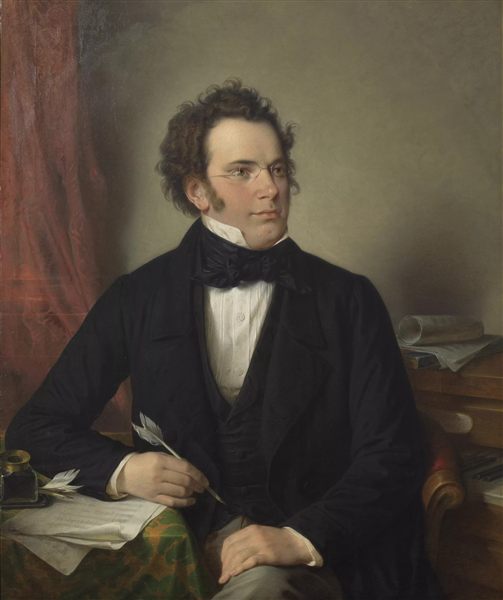
Franz Schubert died at 31, yet left behind one of the largest and most admired catalogues in classical music, including over 600 songs that essentially founded the German Lied as a serious concert form. Where many composers wrote a handful of significant vocal works, Schubert treated the combination of solo voice and piano as a genuinely major outlet, setting poetry by Goethe and others with a melodic gift that's rarely been matched.
Life in brief
Schubert was born in Vienna in 1797, the son of a schoolmaster. A fine singer as a boy, he won a place in the imperial court chapel choir, which came with an education at Vienna's top boarding school; among his teachers there was the court composer Antonio Salieri. He briefly worked as a teacher at his father's school, but his real life was composing - often at astonishing speed. In 1815 alone he wrote around 140 songs.
He never held a steady musical post and rarely earned much from his work. Instead he lived among a circle of devoted friends - poets, painters, and singers - who championed his music at informal evening gatherings that became known as Schubertiads. Only one public concert devoted entirely to his music took place in his lifetime, in March 1828.
In his mid-twenties he contracted a serious illness, probably syphilis, and his health never fully recovered. In his final years he wrote a staggering run of masterpieces, many of them unknown until long after his death. He died in November 1828, aged 31, and was buried, as he had wished, near Beethoven, whom he had idolized.
Music and style
Schubert was above all a melodist - his tunes seem to flow without effort - but he was also a daring harmonist, famous for sudden, magical shifts between major and minor that can turn a phrase from sunshine to shadow in a moment. In his songs, the piano is never mere accompaniment: it paints the scene - a spinning wheel, a galloping horse, a babbling brook.
His Symphony No. 8, nicknamed the "Unfinished," breaks off after only two complete movements - whether from illness, self-doubt, or simply moving on to other projects is still debated - and yet those two movements are considered complete and satisfying enough that the symphony is performed regularly exactly as it stands, unfinished.
Key works
- Erlkönig (1815) - a song he wrote at 18, in which a single singer plays four characters - narrator, father, dying child, and the supernatural Erl-King - over a galloping piano.
- Gretchen am Spinnrade (1814) - written at 17, with the piano as a spinning wheel.
- Winterreise (1827) - a cycle of 24 bleak, wintry songs, one of the peaks of the song repertoire.
- "Unfinished" Symphony (1822) and the "Great" C major Symphony, which Schumann discovered a decade after Schubert's death.
- "Trout" Quintet (1819) and the String Quintet in C (1828) - two of the best-loved works in all chamber music.
- "Death and the Maiden" String Quartet (1824).
- Ave Maria (1825) - originally a song from a setting of Walter Scott.
Legacy
Schubert worked right at the hinge between the Classical and Romantic eras: his structures often echo Haydn and Mozart, while his harmonic language and emotional directness point forward to the Romantics who idolized him after his early death, including Schumann and Brahms. Much of his greatest music was published or performed only after his death, and his reputation has grown ever since.
Where to start listening: "Ave Maria" is his most universally known piece; the "Unfinished" Symphony's first movement shows his gift for melody at orchestral scale. Then try Erlkönig - four minutes of pure drama.