Composer
Bedřich Smetana
The father of Czech music, who wrote his greatest works after going deaf.
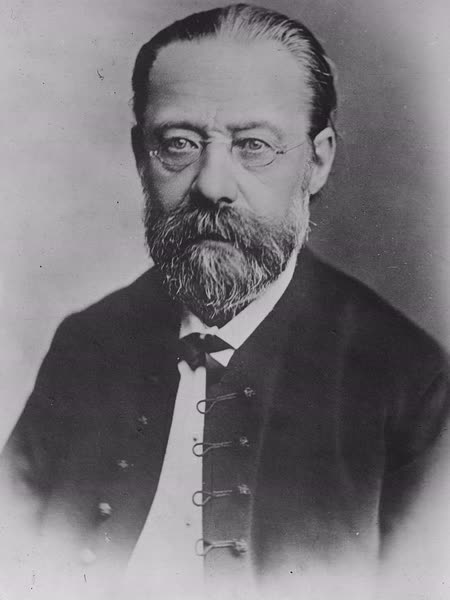
Bedřich Smetana is the father of Czech music. At a time when his homeland of Bohemia was ruled by the Austrian Empire and its culture dominated by German, he set out to create a music that was unmistakably Czech, and his symphonic poem Vltava (The Moldau), which follows a great river through the Czech landscape, is one of the best-loved orchestral pieces in the world.
Life in brief
Smetana was born in 1824 in Litomyšl, in eastern Bohemia, the son of a brewer. He was a gifted pianist as a child, and despite his father's doubts he moved to Prague to study music, scraping a living as a piano teacher. With encouragement from Liszt, he opened a music school, and from 1856 he spent five years in Gothenburg, Sweden, as a conductor and teacher.
He returned to Prague as Czech national feeling was rising, and threw himself into building a Czech musical life. He wrote operas in Czech, and from 1866 he was chief conductor of the Provisional Theatre, the home of Czech opera, where his comic opera The Bartered Bride became a national treasure.
In 1874 disaster struck: within months he went completely deaf, probably as the result of syphilis, and he was forced to give up conducting. Yet in the following years, in silence, he wrote his greatest music, including the six-part cycle Má vlast and his first string quartet. His health and mind gradually failed, and he died in a Prague asylum in 1884.
Music and style
Smetana's music combines the orchestral color and grand forms of Liszt, whom he admired, with the rhythms and melodies of Czech folk dances, especially the lively polka. Rather than quoting folk songs, he wrote original tunes in their spirit. His music celebrates Czech history, legend, and landscape, and it is full of warmth, energy, and pride.
Key works
- Má vlast (My Country, 1874–1879) - a cycle of six symphonic poems about Czech history, legend, and landscape.
- Vltava (The Moldau) - the second poem of Má vlast, tracing the river from two tiny springs, past a hunt, a peasant wedding, and moonlit nymphs, to the rapids and the majestic sweep through Prague.
- The Bartered Bride (1866) - a sparkling comic opera of village life, with a famous overture and dances.
- String Quartet No. 1, "From My Life" (1876) - an autobiographical work whose finale is interrupted by a long, piercing high note: the ringing in his ears that came before his deafness. See string quartet.
- Dalibor (1868) and Libuše (1872, staged 1881) - heroic operas on Czech legends; Libuše opened Prague's National Theatre.
Legacy
Smetana laid the foundation for Czech classical music, opening the way for Dvořák and Janáček. Má vlast opens the Prague Spring festival every year, on the anniversary of his death. See also the Romantic era.
Where to start listening: Vltava - twelve minutes, and the river's flowing theme is unforgettable. Then try the overture to The Bartered Bride and the quartet "From My Life."