Composer
Hector Berlioz
The wildest Romantic of them all, and the great pioneer of the modern orchestra.
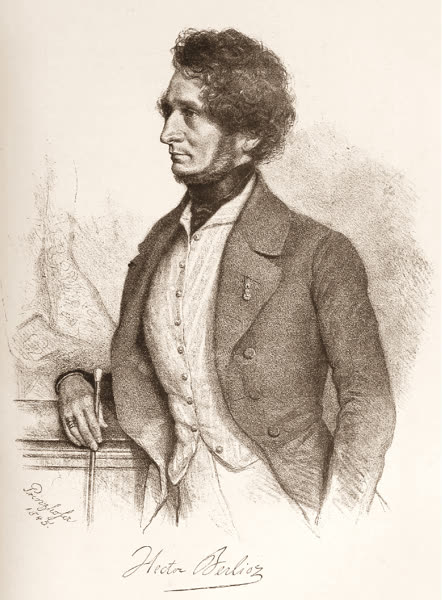
Hector Berlioz was the most radical composer of the early Romantic era - a visionary who imagined music on a scale no one had attempted, wrote one of the most daring symphonies ever composed in his twenties, and transformed the way composers used the orchestra.
Life in brief
Berlioz was born in 1803 in La Côte-Saint-André, in southeastern France, the son of a doctor. He was sent to Paris to study medicine but was so horrified by the dissecting room, and so excited by the city's opera, that he abandoned medicine for music, against his family's wishes. He studied at the Paris Conservatoire and, after several failures, won its Prix de Rome in 1830.
In 1827 he saw the Irish actress Harriet Smithson play Ophelia in Hamlet and fell obsessively in love with her, though they had never met. His unrequited passion inspired the Symphonie fantastique (1830). He eventually married her in 1833, but the marriage was unhappy.
Berlioz never had an easy career in France. His music was considered too strange and too big, and he earned much of his living as a witty, often scathing music critic. He found more appreciation abroad, touring Germany, Russia, and Britain as a conductor of his own works. His last years were lonely, and he died in Paris in 1869. His Memoirs are among the most entertaining books ever written by a composer.
Music and style
Berlioz thought in terms of drama and color. He loved Shakespeare, Goethe, Byron, and Virgil, and his works often tell stories or depict scenes - the heart of program music. He was a supreme orchestrator, inventing new combinations of instruments and effects, and his Treatise on Instrumentation (1844) became a standard textbook. He also loved vast forces: his Requiem calls for four brass bands placed around the hall.
The Symphonie fantastique follows a young artist's fevered dreams of his beloved, represented by a recurring melody, the idée fixe ("fixed idea"), that transforms in each movement - from a ballroom waltz to a march to the scaffold and a witches' sabbath.
Key works
- Symphonie fantastique (1830) - a five-movement program symphony. See symphony and symphonic poem.
- Harold in Italy (1834) - a symphony with solo viola, inspired by a request from Paganini.
- Grande Messe des morts (1837) - his colossal Requiem.
- The Damnation of Faust (1846) - a "dramatic legend" after Goethe, with the rousing "Hungarian March."
- Les nuits d'été - a song cycle for voice and orchestra.
- Les Troyens ("The Trojans") - a vast opera after Virgil, never staged complete in his lifetime.
- Roman Carnival Overture (1844).
Legacy
Berlioz's orchestral imagination influenced Liszt, Wagner, and generations of later composers, and his Treatise was later updated by Richard Strauss. Long underrated in France, he is now recognized as one of the giants of the Romantic era.
Where to start listening: the Symphonie fantastique is the essential Berlioz - start with the "March to the Scaffold." Then try the Roman Carnival Overture, or the songs of Les nuits d'été.