Composer
Robert Schumann
A composer and influential critic, married to one of the era's great pianists.
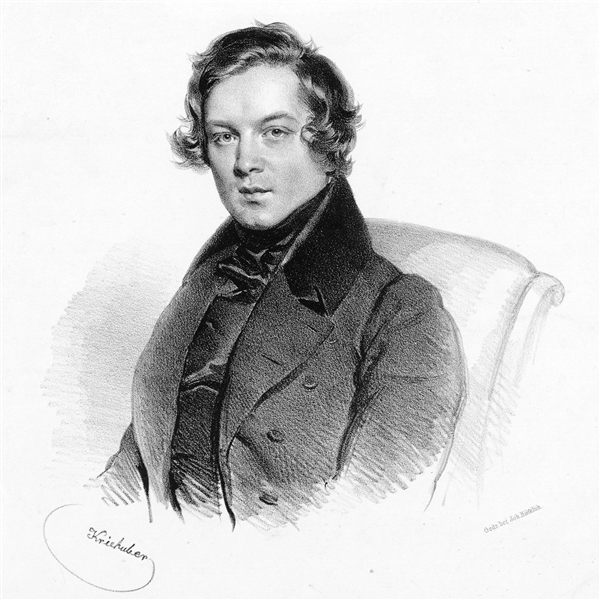
Robert Schumann was both a composer and one of the most influential music critics of his era, using his own journal to champion younger talents - he was among the first to publicly celebrate the young Brahms, correctly predicting his significance years before most of Europe caught on.
Life in brief
Schumann was born in 1810 in Zwickau, in Saxony, the son of a bookseller and publisher, and grew up steeped in literature as much as music. He studied law to please his family, but gave it up to train as a pianist with the leading teacher Friedrich Wieck. An injury to his right hand - according to tradition caused by a device he used to strengthen his fingers - ended his hopes of a performing career, and he turned to composing and writing.
In 1834 he founded a music journal, the Neue Zeitschrift für Musik, and wrote for it under invented personas, including the fiery Florestan and the dreamy Eusebius, who stood for the two sides of his own personality. He had already hailed the young Chopin in print with the famous words "Hats off, gentlemen, a genius!"
He fell in love with Wieck's daughter Clara, a brilliant pianist nine years younger than him. Her father bitterly opposed the match, and the couple had to go to court before they could marry in 1840. That year alone, overflowing with happiness, Schumann wrote well over a hundred songs.
Schumann suffered from severe depression and mental illness throughout his life. In 1854, while music director in Düsseldorf, he threw himself into the Rhine. He was rescued, but spent his last two years in an asylum, where he died in 1856. Clara went on to champion his music for four decades.
Music and style
Schumann's music is prized for its intense emotional directness and literary sensibility - he set an enormous amount of poetry to music and often built entire works around a single vivid poetic or narrative idea. His best piano music comes in cycles of short, characterful pieces - masked figures at a ball, scenes from childhood - full of sudden shifts of mood, hidden musical codes, and private references.
His Piano Concerto in A minor was written in close partnership with his wife, Clara Schumann, herself one of the leading concert pianists of the 19th century and an accomplished composer in her own right; the concerto remains one of the most performed in the Romantic repertoire. His Symphony No. 3, nicknamed the "Rhenish," was inspired by his travels along the Rhine river, including a movement evoking the atmosphere of Cologne Cathedral.
Key works
- Piano Concerto in A minor (1845).
- Four symphonies, including No. 1 "Spring" and No. 3 "Rhenish."
- Dichterliebe ("A Poet's Love") and Frauenliebe und -leben - song cycles from his great "year of song," 1840. See art song.
- Carnaval - a musical masked ball for piano.
- Kinderszenen ("Scenes from Childhood"), including the much-loved "Träumerei."
- Kreisleriana and the Fantasie in C - his most passionate piano works.
- Piano Quintet in E-flat (1842) - a cornerstone of chamber music.
Legacy
Schumann's writing shaped how the 19th century heard music, and his combination of poetry and music - the piano piece as a fleeting mood, the song cycle as a story - became central to Romanticism. His protégé Brahms remained devoted to Clara and her children for the rest of his life.
Where to start listening: the Piano Concerto in A minor's first movement is a good full-scale introduction; his song cycle Dichterliebe shows his literary, text-driven side. "Träumerei" from Kinderszenen is three minutes of pure Romantic reverie.