Instrument
Clarinet
A single-reed woodwind with an unusually wide range and smooth, rounded tone.
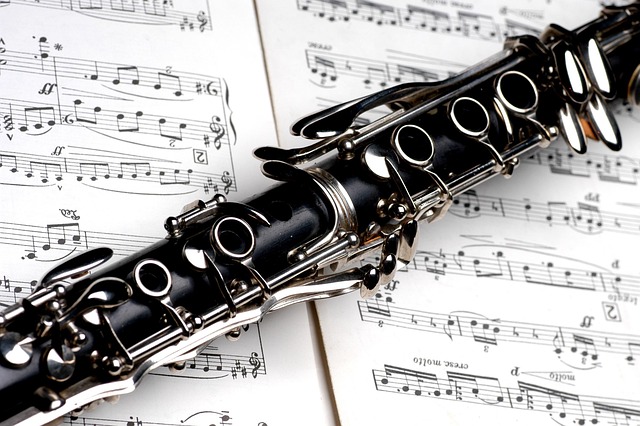
The clarinet, pictured above resting on its sheet music, uses a single reed - one thin strip of cane clamped against a fixed mouthpiece and set vibrating by the player's breath - producing a smoother, more rounded tone than the double-reed oboe and bassoon elsewhere in the woodwind family.
Among the woodwinds, the clarinet has an unusually wide range, and its tone color shifts noticeably across that range - dark and rich in its lowest register (the "chalumeau"), bright and clear at the top - which composers frequently exploit deliberately. It's also unusually agile for its size, capable of extremely fast passagework and wide leaps with relatively little strain.
The clarinet arrived later than the flute, oboe, and bassoon (invented around 1700, standardized through the 1700s), and Mozart was among the first major composers to write extensively and idiomatically for it, including his well-loved Clarinet Concerto, composed for a slightly lower-pitched basset clarinet built specially for his clarinetist friend Anton Stadler.
Unlike most orchestral instruments, the clarinet is a transposing instrument built in more than one size for practical and tonal reasons - orchestral parts are usually written for either a B-flat or an A clarinet, and the player switches instruments mid-piece depending on which better suits a passage's key. A larger relative, the bass clarinet, extends the family's dark, rich low register even further and has its own place in the orchestra. Late in his life, Brahms was so taken with the playing of clarinetist Richard Mühlfeld that he came out of a planned retirement from composing to write four major chamber works featuring the instrument.
Where to start listening: the opening clarinet glissando (a rapid upward slide) at the start of Gershwin's Rhapsody in Blue is one of the instrument's most famous entrances. Brahms's Clarinet Quintet shows the instrument's warmer, more autumnal chamber-music side.