Composer
Felix Mendelssohn
A prodigy as gifted as Mozart, who revived Bach and wrote the Wedding March.
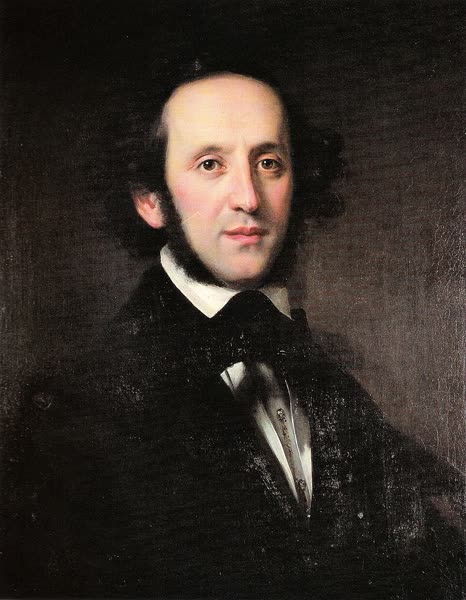
Felix Mendelssohn was one of the most astonishing prodigies in music history - often compared to Mozart - and grew into one of the most influential musicians of the early Romantic era: composer, pianist, conductor, and founder of a conservatory. His music combines Romantic warmth and color with Classical elegance and polish.
Life in brief
Mendelssohn was born in Hamburg in 1809 into a wealthy and cultured family; his grandfather was the celebrated Jewish philosopher Moses Mendelssohn. His parents had their children baptized as Lutherans and added the name "Bartholdy." The family settled in Berlin, where Felix and his older sister Fanny, also a gifted composer, grew up surrounded by the leading writers, scientists, and musicians of the day. As a boy he met the poet Goethe.
His early works were extraordinary: the String Octet at sixteen, and the overture to A Midsummer Night's Dream at seventeen. In 1829, aged just twenty, he conducted Bach's St Matthew Passion in Berlin - its first performance since Bach's death - sparking a revival of Bach's music.
He traveled widely. A trip to Scotland inspired The Hebrides overture and his "Scottish" Symphony; a trip to Italy, his "Italian" Symphony. He visited Britain ten times and was a favorite of Queen Victoria. In 1835 he became conductor of the Gewandhaus Orchestra in Leipzig, making it one of the finest in Europe, and in 1843 he founded the Leipzig Conservatory.
Overwork took its toll. In May 1847 his beloved sister Fanny died suddenly; devastated, Felix died himself that November, aged only 38.
Music and style
Mendelssohn's music is graceful, transparent, and beautifully crafted, with a special gift for light, quicksilver textures - the fairy music of A Midsummer Night's Dream is the classic example. He loved Bach and Handel and wrote fugues and oratorios in their tradition, but his melodies and his evocative orchestral landscapes are thoroughly Romantic.
Key works
- A Midsummer Night's Dream - the overture (1826) and later incidental music (1842), including the Wedding March, which became a wedding staple after Queen Victoria's eldest daughter chose it in 1858.
- Violin Concerto in E minor (1844) - one of the most loved violin concertos ever written. See violin.
- The Hebrides ("Fingal's Cave," 1830) - a stormy seascape overture.
- Symphonies No. 3, "Scottish," and No. 4, "Italian."
- Elijah (1846) - an oratorio in the tradition of Handel, premiered in Birmingham.
- String Octet (1825) - see chamber music.
- Songs without Words - short, lyrical piano pieces for home playing.
Legacy
Mendelssohn's reputation suffered later in the 19th century, partly through antisemitic attacks - including one by Wagner - and under the Nazis his music was banned and his statue in Leipzig torn down. Today he is firmly restored as one of the great composers, and his championing of Bach changed music history.
Where to start listening: the overture to A Midsummer Night's Dream is pure magic; the Violin Concerto's first movement is irresistible. Then try The Hebrides overture for his genius as a painter in sound.