Composer
Jacques Offenbach
The king of operetta - and the man behind the can-can.
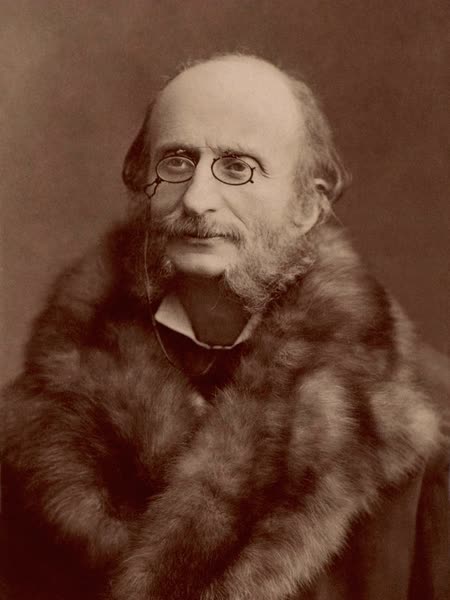
Jacques Offenbach was the master of French operetta, a witty, tuneful form of light comic opera that he practically invented. His Orpheus in the Underworld gave the world the most famous can-can ever written, and his last work, the opera The Tales of Hoffmann, contains one of the most beautiful melodies in all music, the Barcarolle.
Life in brief
Offenbach was born in Cologne, Germany, in 1819, the son of a synagogue cantor and music teacher. At fourteen he was taken to Paris, where he briefly studied cello at the Conservatoire, played in the orchestra of the Opéra-Comique, and became a celebrated cello virtuoso in the salons.
His real ambition was the theatre. Frustrated that the established theatres ignored him, in 1855 he opened his own small theatre, the Bouffes-Parisiens, and began producing short comic operas. Orpheus in the Underworld (1858), a cheeky parody of Greek myth and of Parisian society, was a huge hit, and throughout the 1860s his operettas made him the toast of Napoleon III's Second Empire.
After the fall of the Empire in 1870, his popularity dipped, and he had financial troubles. In his last years he devoted himself to a serious opera, The Tales of Hoffmann, but he died in Paris in 1880, before it was finished. It was completed by others and premiered the following year to great success.
Music and style
Offenbach's music sparkles with energy, irresistible melodies, and comic timing. His operettas satirize gods, kings, generals, and the fashionable society of Paris, with dazzling ensembles, waltzes, galops, and patter songs. Beneath the fun lay real craft and a gift for heartfelt melody, which comes to the fore in The Tales of Hoffmann.
Key works
- Orpheus in the Underworld (1858) - a mythological romp, ending with the wild "Infernal Galop," the music of the can-can.
- The Tales of Hoffmann (1881) - a fantastic opera in which the poet Hoffmann recalls three doomed loves.
- Barcarolle, "Belle nuit, ô nuit d'amour" - the gently rocking duet from Hoffmann, one of the most famous tunes in opera.
- La belle Hélène (1864) - a satire of the story of Helen of Troy.
- La Vie parisienne (1866) - a celebration of the pleasures of Paris.
Legacy
Offenbach wrote about a hundred stage works and created a genre. His success inspired Johann Strauss II to write operettas, and Gilbert and Sullivan in England followed his example. The can-can, in particular, has become a symbol of Paris itself. See also the Romantic era.
Where to start listening: the "Infernal Galop" from Orpheus in the Underworld - the can-can - then the Barcarolle from The Tales of Hoffmann.