Composer
Anton Bruckner
The humble church organist who built symphonies like cathedrals.
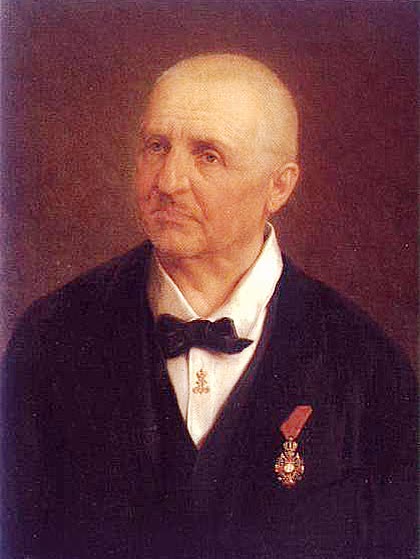
Anton Bruckner was a modest, deeply religious country organist who became one of the great symphonists of the 19th century. His symphonies are vast and slow-moving, built from huge blocks of sound and long, glowing climaxes, and listeners often compare them to cathedrals - music of awe and devotion on an enormous scale.
Life in brief
Bruckner was born in 1824 in Ansfelden, a village in Upper Austria, the son of the village schoolmaster. After his father's death he became a choirboy at the nearby monastery of St. Florian, and he trained as a schoolteacher like his father. He returned to St. Florian as organist, and in 1855 became organist of the cathedral in Linz.
He was a remarkably late developer. Well into his thirties he was still studying harmony and counterpoint, partly by correspondence, with the strict Viennese theorist Simon Sechter, and he did not write his first important works until he was nearly forty. A decisive moment came in 1863, when he discovered the music of Wagner, whom he worshipped for the rest of his life.
In 1868 he moved to Vienna as a professor at the Conservatory. He became famous as an organist, astonishing audiences with his improvisations in Paris and London, but his symphonies met with incomprehension and hostility, especially from the powerful critic Eduard Hanslick, champion of Brahms. Real success came only in his sixties, with the Seventh Symphony. He died in Vienna in 1896, with his Ninth Symphony unfinished, and was buried beneath the great organ at St. Florian.
Music and style
A Bruckner symphony often begins with a shimmering string tremolo, out of which a theme slowly rises, and it unfolds in massive paragraphs separated by dramatic pauses, like an organist changing stops. Brass chorales, broad crescendos, and long, slow movements of deep spirituality are hallmarks. He was also an anxious reviser who reworked several symphonies again and again, often on the advice of well-meaning friends, so many of his works exist in different versions - a puzzle known as the "Bruckner problem."
Key works
- Symphony No. 4, "Romantic" (1874, revised 1878–1880) - his most popular symphony, opening with a horn call over trembling strings.
- Symphony No. 7 (1883) - his first great triumph. He wrote its slow movement anticipating Wagner's death, and added a funeral coda when the news came, scored for the special "Wagner tubas."
- Symphony No. 8 (1887, revised 1890) - his grandest completed symphony.
- Symphony No. 9 (1887–1896) - left with three movements, which he dedicated "to the beloved God." See symphony.
- Te Deum (1884) - a blazing choral hymn of praise.
- Motets, including Locus iste, Os justi, and Christus factus est - short, luminous works for choir. See motet.
Legacy
Bruckner's symphonies influenced Mahler, who attended his lectures and admired him greatly, and they paved the way for the vast symphonic structures of the early 20th century. Once considered long-winded, they are now pillars of the orchestral repertoire, especially beloved for their brass writing. See also the organ and the Romantic era.
Where to start listening: the opening of Symphony No. 4 is a perfect way in. Then try the slow movement of Symphony No. 7, and the motet Locus iste, just three minutes long.