Composer
Gioachino Rossini
The king of Italian comic opera - who stopped writing operas at 37.
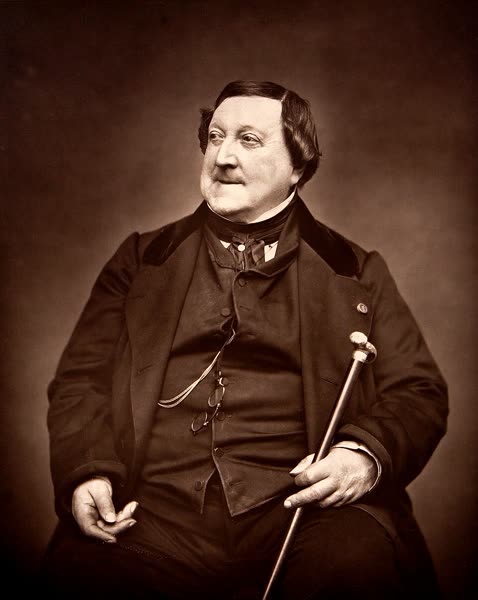
Gioachino Rossini was the most famous and successful opera composer in Europe in the early 19th century. His comic operas sparkle with wit and irresistible tunes, and The Barber of Seville has never left the stage. Then, at the height of his fame and aged just 37, he stopped writing operas altogether.
Life in brief
Rossini was born in 1792 in Pesaro, on Italy's Adriatic coast - on February 29th, so he had a real birthday only once every four years. His father was a horn player and his mother a singer, and he grew up in the world of the theater. He studied in Bologna and had his first opera staged in Venice at eighteen.
He wrote with legendary speed, often several operas a year, borrowing and reusing his own music when deadlines pressed. The Barber of Seville (1816) was reportedly composed in about three weeks. Its first night in Rome was a fiasco, disrupted by supporters of a rival composer, but it soon became a triumph. By his thirties Rossini was an international celebrity, and he moved to Paris, where he wrote his grand opera William Tell (1829).
It was his last opera. For the remaining four decades of his life he wrote no more for the stage, for reasons that are still debated - ill health, depression, exhaustion, changing tastes, and simple financial security all played a part. He lived in Paris, famous for his wit, his Saturday-evening musical salons, and his love of fine food; a dish, Tournedos Rossini, is named after him. He died near Paris in 1868.
Music and style
Rossini's music is brilliant, elegant, and full of energy. He was the great master of bel canto ("beautiful singing") opera, with vocal lines full of dazzling runs and ornaments for virtuoso singers. His trademark was the Rossini crescendo: a short phrase repeated again and again, growing louder and adding instruments each time, until the whole orchestra is roaring. His comic timing, especially in ensembles where characters sing faster and faster over each other, is unmatched.
Key works
- The Barber of Seville (1816) - his comic masterpiece, with Figaro's "Largo al factotum." See opera.
- La Cenerentola (1817) - his version of the Cinderella story.
- L'italiana in Algeri (1813) - an early comic hit.
- William Tell (1829) - a grand historical opera whose overture, with its galloping finale, became the theme of The Lone Ranger.
- Stabat Mater (1841) and the Petite messe solennelle (1863) - the major works of his later years.
- Péchés de vieillesse ("Sins of Old Age") - over 150 witty piano pieces and songs written in retirement.
Legacy
Rossini shaped Italian opera for a generation, paving the way for the bel canto composers Bellini and Donizetti and for the young Verdi. His overtures remain concert favorites, and his comic operas are among the most performed in the world.
Where to start listening: the overture to The Barber of Seville is a perfect taste of his wit and energy. Then hear "Largo al factotum," and the William Tell Overture's famous finale.