Instrument
Organ (Pipe Organ)
A keyboard instrument that pushes air through pipes instead of striking strings.
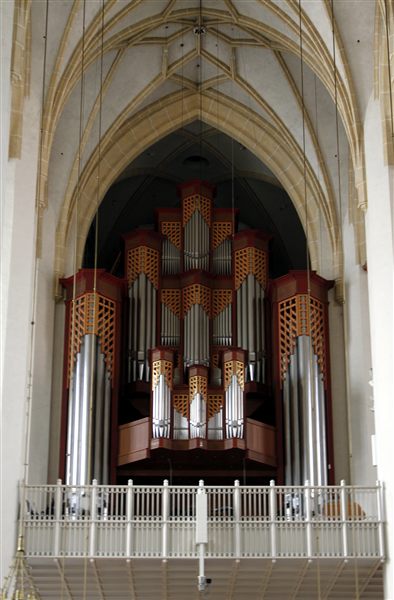
The pipe organ is played from a keyboard (often several, called manuals, plus a keyboard for the feet called a pedalboard), but produces sound completely differently from the piano: pressing a key opens a valve that lets air flow through one or more pipes, each pipe built to sound a specific pitch and tone color.
How it works
A large organ can have thousands of individual pipes, organized into ranks - sets of pipes of one tone color, one pipe per note. The player chooses which ranks sound by pulling out stops, knobs or tabs with names that hint at their sound: Principal or Diapason (the organ's core tone), Flute, Trumpet, and even Vox humana ("human voice"). Pipes range from the size of a pencil to more than thirty feet tall, and the longest produce notes so low they're felt as much as heard. The phrase "pulling out all the stops" comes straight from the organ.
That mechanism lets a single organist control an enormous range of tone color and volume - from a single whisper-quiet pipe to the full combined weight of every rank sounding together - making the organ one of the loudest and most texturally varied instruments in existence. Unlike a piano note, an organ note doesn't fade: it sounds at full strength for as long as the key is held. Strictly speaking, the organ is a wind instrument played from a keyboard.
A long history
The earliest ancestor of the organ, the hydraulis, was invented in ancient Greece in the 3rd century BC, using water pressure to supply the air. By the Middle Ages the organ had found its home in the church, where large pipe organs have been installed for centuries specifically because they can fill vast stone buildings with sound, and much of the core organ repertoire (including Bach's organ works) was written for exactly that setting. Bach was the most famous organist of his day, and the great instruments of Baroque northern Germany shaped his music.
In 19th-century France, the organ builder Aristide Cavaillé-Coll created huge "symphonic" organs capable of orchestral colors, and composers such as César Franck and Charles-Marie Widor wrote organ symphonies for them. In the early 20th century, cinemas installed theater organs to accompany silent films. Olivier Messiaen, organist at a Paris church for six decades, wrote some of the most startling organ music of the 20th century.
The organ with the orchestra
Composers occasionally add the organ to the orchestra for overwhelming power: Camille Saint-Saëns's Symphony No. 3, the "Organ" Symphony, Richard Strauss's Also sprach Zarathustra, and Holst's The Planets all use it to shattering effect.
Essential organ music
- Bach - Toccata and Fugue in D minor (attributed), the "Little" Fugue, and the chorale preludes.
- Buxtehude - preludes and toccatas, which young Bach walked hundreds of miles to hear.
- Widor - Toccata from his Organ Symphony No. 5 - a favorite wedding recessional.
- Saint-Saëns - Symphony No. 3, "Organ" (1886).
- Messiaen - La Nativité du Seigneur (1935).
Where to start listening: Bach's Toccata and Fugue in D minor is the instrument's single most widely recognized piece. For the organ at full French glory, try Widor's Toccata - and if you can, hear an organ live, since recordings can't capture the way it fills a building.