Composer
Benjamin Britten
A 20th-century modernist best known for a piece written to teach children the orchestra.
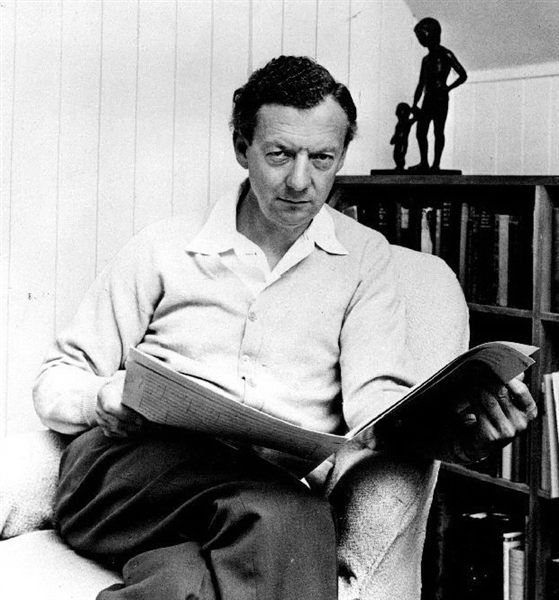
Benjamin Britten was the leading British composer of the mid-20th century, working across opera, orchestral music, and choral music with a distinctly modern harmonic language that never fully abandoned melody and clear structure the way some of his continental contemporaries did.
Life in brief
Britten was born in 1913 in Lowestoft, on the Suffolk coast, on St Cecilia's Day - the feast of the patron saint of music. He was composing prolifically as a boy, studied privately with the composer Frank Bridge, and then at the Royal College of Music in London. In the 1930s he wrote music for documentary films, collaborating with the poet W. H. Auden.
A pacifist, he left for the United States in 1939 with the tenor Peter Pears, his partner in life and music for nearly forty years - at a time when homosexuality was illegal in Britain. Reading the poetry of George Crabbe made him homesick for the Suffolk coast, and he returned in 1942 as a conscientious objector. The opera that resulted, Peter Grimes (1945), was a triumph and helped revive serious English-language opera as a living tradition in the 20th century.
In 1948 Britten and Pears founded the Aldeburgh Festival in their Suffolk home town, which they ran for the rest of their lives. Britten wrote a stream of operas, often with leading roles for Pears, along with choral music and works for children and amateurs. In 1976, months before his death, he became the first composer to be made a life peer.
Music and style
Britten's music is lucid, economical, and superbly crafted for its performers, with a gift for vivid word-setting and atmosphere - the sea, above all, runs through his work. His operas often explore outsiders pitted against a hostile community, and the loss of innocence. He wrote with special care for young performers and amateurs, believing music should be useful to the people who make it.
His most widely known work by far is The Young Person's Guide to the Orchestra, commissioned for an educational documentary film and built specifically to introduce every section of the orchestra in turn - strings, woodwinds, brass, and percussion - each playing a theme by Purcell before the whole orchestra combines it into a closing fugue. It remains one of the most effective, widely used pieces for teaching listeners of any age how to identify individual instruments by ear.
Key works
- The Young Person's Guide to the Orchestra (1946).
- Peter Grimes (1945) - a fisherman driven out by his village; its orchestral "Four Sea Interludes" are often performed on their own.
- A Ceremony of Carols (1942) - for treble voices and harp.
- War Requiem (1962) - written for the consecration of the rebuilt Coventry Cathedral, setting the Latin requiem alongside Wilfred Owen's First World War poems.
- Other operas - Billy Budd, The Turn of the Screw, A Midsummer Night's Dream, and Death in Venice.
- Noye's Fludde (1958) - the story of Noah, for children and amateurs to perform.
- Simple Symphony (1934) - a youthful work for strings built from tunes he wrote as a child.
Legacy
Britten put British music back at the center of the international scene and created the most important body of English-language opera since Purcell. His operas are performed worldwide, and the festival he founded at Aldeburgh still thrives.
Where to start listening: The Young Person's Guide to the Orchestra remains one of the best possible companions to this site's own Instruments section. Then try the "Four Sea Interludes" from Peter Grimes - the sea, in sound.