Composer
Aaron Copland
The composer who gave American concert music its own distinct sound.
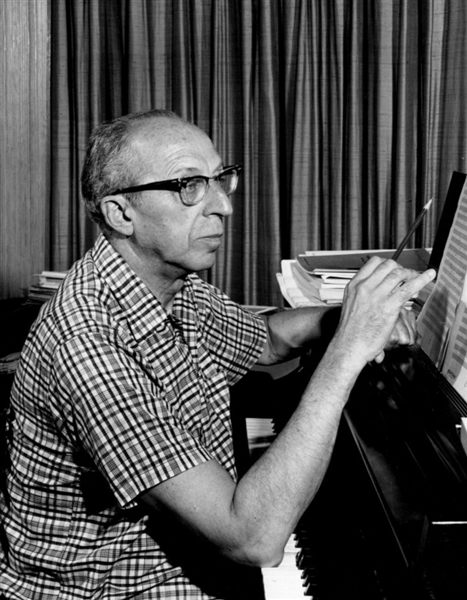
Aaron Copland set out deliberately to create a concert-music sound that felt distinctly American rather than an import of European tradition, drawing on open, spacious harmony, folk melody, and rhythms borrowed from jazz. That sound proved so influential that it's now closely associated with "American" orchestral music generally, showing up constantly in film and television underscoring the American West, rural life, or national pride.
Life in brief
Copland was born in Brooklyn, New York, in 1900, the youngest child of Jewish immigrants from the Russian Empire, who ran a department store. He learned piano from an older sister and, determined to compose, went to Paris in 1921 to study with the legendary teacher Nadia Boulanger - one of the first of a long line of American composers she trained.
His early music back home was spiky and jazz-influenced, the sound of modern New York. In the 1930s, during the Depression, he decided he wanted to reach ordinary listeners rather than a small circle of specialists, and he began writing in a simpler, more open style. A run of works followed that defined his reputation - El Salón México, the cowboy ballets Billy the Kid and Rodeo, Fanfare for the Common Man, and Appalachian Spring, which won the Pulitzer Prize for Music in 1945. He also wrote for Hollywood, winning an Academy Award for his score to The Heiress (1949).
In 1953, during the McCarthy era, his left-wing sympathies led to his being called before a Senate subcommittee, and his Lincoln Portrait was dropped from President Eisenhower's inaugural concert. In later decades he experimented with twelve-tone technique, conducted widely, and taught generations of young composers, especially at the Tanglewood summer music school. He died in 1990.
Music and style
The "Copland sound" is built on wide-open intervals and spacious chords that evoke vast landscapes, clear and transparent orchestration, folk and hymn tunes, and lively, jazzy rhythms. It's direct without being simple: his craftsmanship, honed in Paris, is precise and economical.
His ballet Appalachian Spring, scored originally for a small ensemble, incorporates the Shaker tune "Simple Gifts" into one of the most recognizable passages in American concert music. Fanfare for the Common Man, written for brass and percussion alone, has become a kind of unofficial anthem for ceremonial occasions, its stark, wide-open intervals instantly recognizable.
Key works
- Appalachian Spring (1944) - written for the choreographer Martha Graham.
- Fanfare for the Common Man (1942) - a wartime tribute, later reused in the finale of his Symphony No. 3.
- Rodeo (1942) - its "Hoe-Down" became famous all over again in a long-running American beef advertising campaign.
- Billy the Kid (1938) - a ballet on the outlaw's life.
- Lincoln Portrait (1942) - orchestra with a narrator reading Lincoln's words.
- Symphony No. 3 (1946) - his grandest orchestral statement.
- Clarinet Concerto (1948) - written for the jazz clarinetist Benny Goodman.
Legacy
Copland was also an influential teacher and writer - his book What to Listen For in Music is still in print - doing as much as any American composer of his generation to build a serious concert-music culture in the United States rather than simply importing European models wholesale. His open-prairie sound became the default musical language for the American landscape in film, and composers from Leonard Bernstein to John Williams learned from it.
Where to start listening: Fanfare for the Common Man is under four minutes and immediately striking; Appalachian Spring rewards a longer, fuller listen. For pure energy, try "Hoe-Down" from Rodeo.