Instrument Family
The String Family
Violin, viola, cello, and double bass - bowed strings, the backbone of the orchestra.
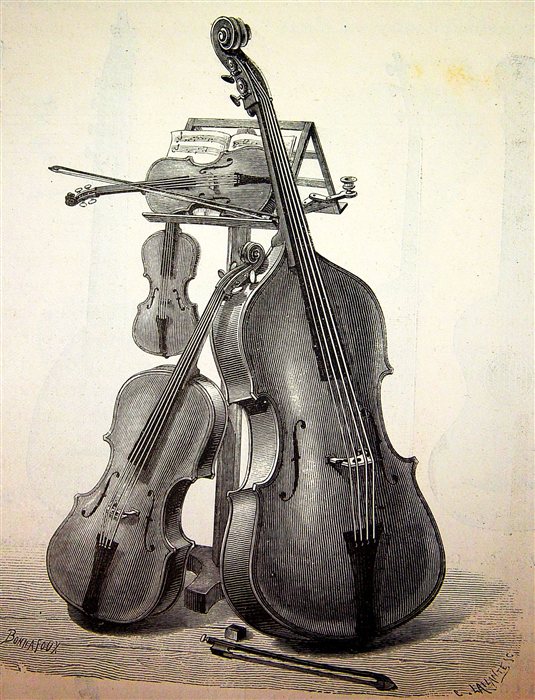
The string family is built from four sizes of essentially the same instrument - a wooden body, four strings, and a bow drawn across them - tuned to different ranges: the violin (highest), viola, cello, and double bass (lowest). Because they share the same basic mechanism, they blend together unusually well, which is why strings form the largest section of a standard orchestra and carry most of its melodic material.
All four are played by drawing a horsehair bow across the strings (arco), though players can also pluck the strings directly (pizzicato) for a shorter, percussive sound. Pitch is controlled by pressing the strings down against the instrument's neck with the left hand, shortening the vibrating length of string, while the right hand controls the bow's speed, pressure, and placement - together producing an enormous range of tone color from a single sustained note.
The harp is also a string instrument, but works differently - its strings are plucked directly rather than bowed, and it's tuned by an elaborate system of foot pedals rather than fingering, which sets it apart from the bowed-string core of the family.
Where to start listening: any string quartet recording makes the four bowed sizes easy to compare side by side; listen for how the same phrase sounds different in the violin's bright upper range versus the cello's warmer low register.