Composer
Béla Bartók
The Hungarian modernist who found his voice in the folk music of the villages.
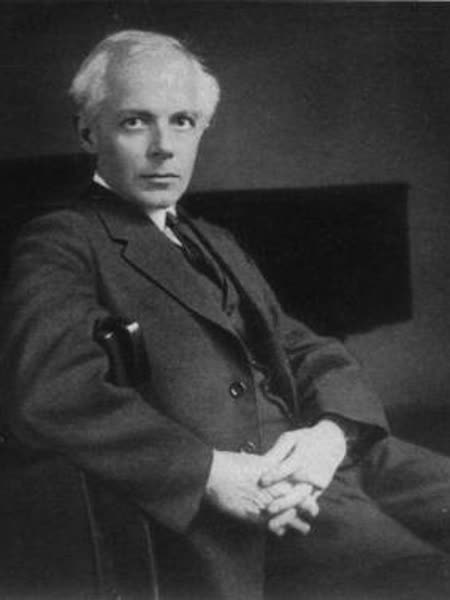
Béla Bartók was one of the giants of 20th-century music. By traveling to remote villages and recording peasant songs, he discovered a world of rhythm, harmony, and melody that transformed his music, and he fused it with the most advanced techniques of his time to create a style that is fierce, earthy, and utterly original.
Life in brief
Bartók was born in 1881 in a small town in the Kingdom of Hungary, now part of Romania. His mother, a piano teacher, gave him his first lessons, and he became a superb pianist, studying and later teaching at the Academy of Music in Budapest.
His turning point came in 1905 and 1906, when he and his friend, the composer Zoltán Kodály, began collecting folk music. Carrying a phonograph that recorded on wax cylinders, they traveled through Hungarian, Romanian, Slovak, and other villages, and Bartók went on to collect and transcribe thousands of melodies, publishing scholarly studies of them. This was real peasant music, very different from the polished "gypsy" style that city audiences thought of as Hungarian, and it changed everything he wrote.
A fierce opponent of fascism, he refused to let his music be broadcast in Nazi Germany and Fascist Italy, and in 1940 he emigrated to the United States. His American years were hard: he was poor, little known, and increasingly ill with leukemia. A commission from the conductor Serge Koussevitzky led to his Concerto for Orchestra (1943), a great success, but he died in New York in 1945. His remains were returned to Hungary in 1988.
Music and style
Bartók's music combines the irregular rhythms, unusual scales, and raw energy of folk music with dissonant modern harmony and tightly organized structures. It can be savage and percussive - he treated the piano almost as a drum - or eerily still, as in his "night music," which evokes the sounds of nature after dark. He also made famous the "Bartók pizzicato," in which a string is plucked so hard that it snaps against the fingerboard.
Key works
- Concerto for Orchestra (1943) - a concerto in which every section takes a turn as soloist. See concerto.
- Music for Strings, Percussion and Celesta (1936) - opening with a slowly unfolding fugue; its eerie slow movement featured in the film The Shining.
- String Quartets Nos. 1 - 6 (1908 - 1939) - cornerstones of modern chamber music. See string quartet.
- Romanian Folk Dances (1915) - short, lively arrangements of folk tunes.
- Mikrokosmos - 153 progressive piano pieces, from beginner to concert level.
- Bluebeard's Castle - a dark, one-act opera.
- Piano Concerto No. 3 (1945) - a gentle, sunlit work for his wife, nearly finished at his death.
Legacy
Bartók showed that folk music could be the basis of the most modern, sophisticated art, and his rhythmic drive and harmonic imagination influenced composers worldwide. He was also a pioneer of ethnomusicology - the study of music in its cultural context - and his recordings and transcriptions remain invaluable.
Where to start listening: the Romanian Folk Dances are short, catchy, and a perfect introduction. Then try the Concerto for Orchestra, especially its playful second movement, "Game of Pairs."