Composer
Gustav Holst
The composer of The Planets - a teacher, a trombonist, and a mystic.
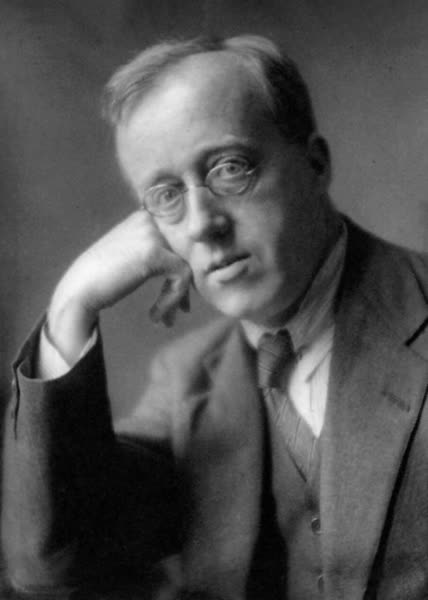
Gustav Holst is known around the world for one work, The Planets, whose menacing "Mars" and noble "Jupiter" have shaped the sound of film music ever since. But he was a far more varied and unusual composer than that one piece suggests: a devoted teacher, a student of Sanskrit, and a lifelong experimenter.
Life in brief
Holst was born in Cheltenham, England, in 1874, into a family of musicians of Swedish, Latvian, and German descent; he was originally named Gustavus von Holst, and dropped the "von" during the First World War. Neuritis in his right arm made a career as a pianist impossible, so while studying composition at the Royal College of Music he took up the trombone, and he earned his living for a time playing in orchestras and opera companies. At college he met Ralph Vaughan Williams, who became his closest friend and musical confidant for life.
From 1905 until his death he was director of music at St Paul's Girls' School in London, where he wrote some of his best-loved music for his students, and he also taught adult amateurs at Morley College. He was fascinated by Hindu philosophy, learned Sanskrit so he could translate texts for his own settings, and was interested in astrology - the spark for The Planets.
The Planets, written between 1914 and 1916, was first performed privately in 1918 and quickly made him famous. Holst disliked the fame and kept writing music that was often more austere and experimental. He died in London in 1934.
Music and style
Holst's music ranges from folk-song simplicity to bold, modern experiment: pounding irregular rhythms, unusual time signatures (the five beats to a bar of "Mars"), clashing harmonies, and vivid orchestral color. He loved English folk song and the music of the Tudor composers, but also looked far beyond England for inspiration. Much of his music was written for amateurs and students, with a strong belief in music-making as something everyone should take part in.
Key works
- The Planets (1914 – 1916) - a seven-movement orchestral suite, one movement for each planet then known (except Earth); the composer Colin Matthews added a "Pluto" in 2000.
- St Paul's Suite (1913) - a lively suite for strings, written for his school orchestra.
- First and Second Suites for Military Band (1909, 1911) - cornerstones of the wind band repertoire.
- Egdon Heath (1927) - a bleak, haunting tone poem after Thomas Hardy, which Holst considered his finest work.
- "In the Bleak Midwinter" (1906) - his setting of Christina Rossetti's poem, a much-loved Christmas carol.
- "I Vow to Thee, My Country" - a hymn adapted from the big tune in "Jupiter."
Legacy
The Planets became a blueprint for orchestral film music - the ominous march of "Mars" can be heard echoing through many a science-fiction battle scene - and it remains one of the most popular orchestral works ever written. His daughter, Imogen Holst, became a respected composer and conductor and championed his music.
Where to start listening: "Mars, the Bringer of War" and "Jupiter, the Bringer of Jollity" from The Planets are the essential first listen. Then try the gentle "Venus," or the St Paul's Suite.