Composer
Gabriel Fauré
The master of French song, whose Requiem is a lullaby of peace.
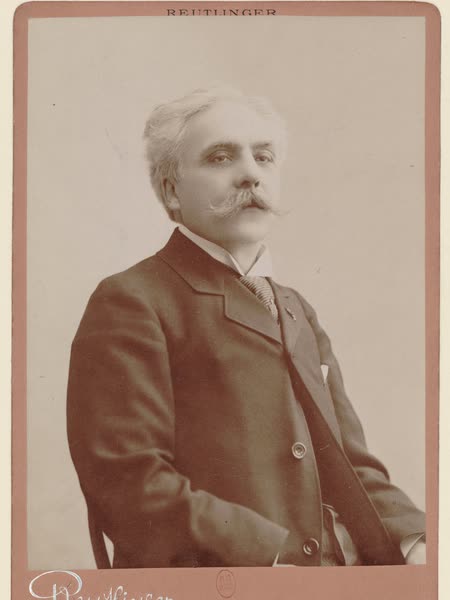
Gabriel Fauré was the great master of French song and one of the most refined composers of his time. His music is elegant, intimate, and quietly adventurous, and his Requiem, gentle and consoling, has become one of the most loved choral works in the repertoire. As a teacher, he shaped a whole generation of French composers, including Ravel.
Life in brief
Fauré was born in 1845 in Pamiers, a town in the south of France near the Pyrenees, the youngest of six children. His musical gift showed early, and at nine he was sent to the École Niedermeyer in Paris, a school that trained church musicians. There, from 1861, he was taught by the young Saint-Saëns, who introduced him to the music of Liszt and Wagner and became a lifelong friend.
For decades Fauré earned his living as a church organist and choirmaster, eventually at the grand Church of the Madeleine in Paris, while teaching and composing in his spare time, often during summer holidays. Recognition came slowly. In 1896 he became professor of composition at the Paris Conservatoire, where his pupils included Ravel and Nadia Boulanger, and in 1905 he was made its director, modernizing the institution over fifteen years.
In his last two decades Fauré suffered increasing deafness, which distorted his hearing of pitch - a cruel fate for a composer. He kept it hidden for as long as he could, and continued to write some of his most profound music. He died in Paris in 1924.
Music and style
Fauré's style bridges the Romantic and the modern. His melodies are long and supple, and his harmony slips constantly and smoothly into unexpected keys, giving his music its characteristic floating, ambiguous quality. He avoided grand rhetoric, preferring restraint, subtlety, and understatement. His more than one hundred songs, his piano nocturnes and barcarolles, and his chamber music are at the heart of his achievement, and his later works grew more austere and inward.
Key works
- Requiem (1887–1890, later expanded) - a serene setting that omits most of the terrifying Day of Judgment and ends in paradise. Fauré called his view of death "a happy deliverance." See requiem.
- Pavane (1887) - a slow, wistful dance with a haunting flute melody.
- "Après un rêve" (c. 1877) - a much-loved song of a lost dream, often played on cello or violin. See art song.
- Élégie (1880) - a deeply expressive piece for cello and piano.
- Cantique de Jean Racine (1865) - a tender choral work written while he was still a student.
- Dolly Suite (1893–1896) - charming pieces for piano duet, written for a friend's young daughter.
Legacy
Fauré's subtle harmonies influenced Ravel, Debussy, and many others, and through Nadia Boulanger's teaching his ideals reached composers around the world, including Copland and Philip Glass. His Requiem, Pavane, and songs remain favorites everywhere.
Where to start listening: the Pavane is four minutes of pure melancholy beauty. Then try the "Pie Jesu" and "In Paradisum" from the Requiem, and the song "Après un rêve."