Composer
Pietro Mascagni
The overnight sensation whose one-act opera launched the age of verismo.
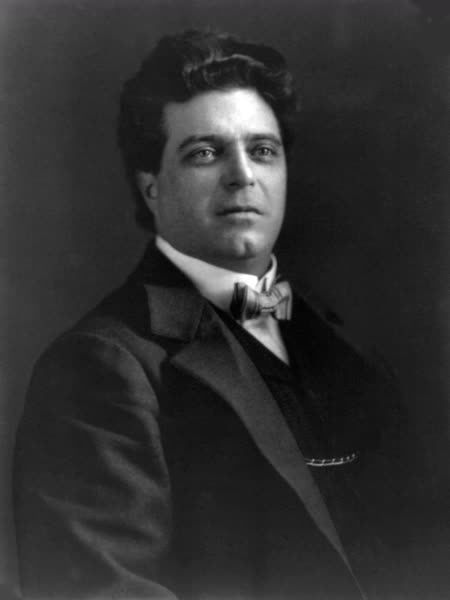
Pietro Mascagni became famous overnight. In 1890, an unknown, impoverished music teacher of twenty-six, he won a competition with a short opera, Cavalleria rusticana, which caused a sensation at its premiere and swept the opera houses of the world. It launched verismo, the realistic style of Italian opera about the passions of ordinary people.
Life in brief
Mascagni was born in 1863 in Livorno, in Tuscany, the son of a baker who hoped he would become a lawyer. Against his father's wishes he studied music, and he went to the Milan Conservatory, where he studied with Amilcare Ponchielli, but he left without finishing and spent years as a conductor for touring opera companies. He then settled as a music teacher in the small town of Cerignola, in southern Italy.
In 1888 the publisher Edoardo Sonzogno announced a competition for one-act operas. Mascagni's Cavalleria rusticana ("Rustic Chivalry"), a tale of jealousy and revenge in a Sicilian village, won first prize, and its premiere in Rome in May 1890 was a triumph, with dozens of curtain calls. He became a celebrity almost at once.
He wrote more than a dozen more operas over the next fifty years, and some, such as L'amico Fritz and Iris, were successful, but none matched his first triumph. He also became a famous conductor. In later life his association with Mussolini's Fascist regime tarnished his reputation, and he died in Rome in 1945, shortly after the end of the Second World War.
Music and style
Cavalleria rusticana is short, fierce, and direct: passionate melodies, vivid choruses, and violent emotions, all within about seventy minutes. Its mixture of everyday characters, Sicilian color, and raw drama defined verismo. Mascagni's gift for soaring melody and theatrical impact is most famous in the serene Intermezzo, a moment of calm before the tragedy.
Key works
- Cavalleria rusticana (1890) - the one-act opera that made him famous, often paired with Leoncavallo's Pagliacci in a double bill nicknamed "Cav and Pag." See opera.
- Intermezzo - the opera's beautiful orchestral interlude, heard in many films, including Raging Bull and The Godfather Part III.
- Easter Hymn ("Inneggiamo") - a magnificent scene for soprano and chorus outside the church on Easter morning.
- L'amico Fritz (1891) - a gentle comedy, with the charming "Cherry Duet."
- Iris (1898) - an opera set in Japan, with a famous "Hymn to the Sun."
Legacy
Cavalleria rusticana remains one of the most performed operas in the world, and it inspired a wave of verismo operas by Leoncavallo, Puccini, and others. See also our glossary of opera terms.
Where to start listening: the Intermezzo from Cavalleria rusticana, then the Easter Hymn and the whole opera.