Composer
Philip Glass
The composer whose name became shorthand for minimalism itself.
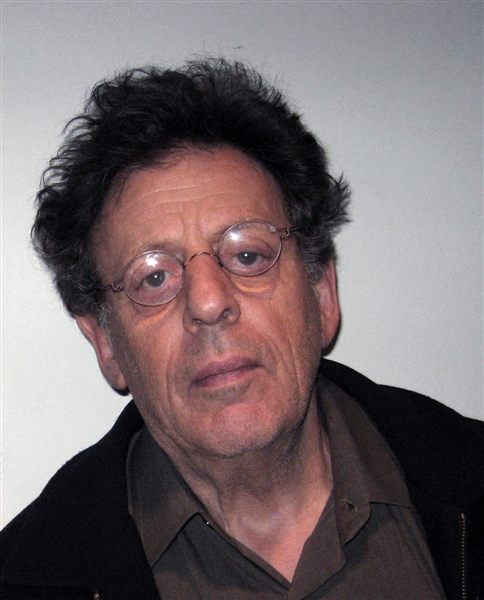
Philip Glass is one of the central figures behind minimalism, building his music from small repeating patterns that shift gradually rather than through the dramatic contrast that drives most earlier classical music - a style so closely tied to his name that "Glass-like" has become a genuine shorthand for the sound of steady, evolving repetition. (Glass himself has long disliked the "minimalist" label, preferring to describe his work as music with repetitive structures.)
Life in brief
Glass was born in Baltimore in 1937. His father ran a record store, and Glass grew up listening to whatever didn't sell. He entered the University of Chicago at fifteen, then studied composition at the Juilliard School in New York and, like Copland before him, with Nadia Boulanger in Paris.
The turning point came in Paris in the mid-1960s, when he was hired to help notate music by the Indian sitar master Ravi Shankar for a film. Indian music's way of building long structures from rhythmic cycles changed his thinking completely. Back in New York, he formed the Philip Glass Ensemble in 1968 - amplified keyboards, winds, and voice - and played his music in lofts and galleries rather than concert halls. For years he supported himself with other work, including driving a taxi and working as a plumber.
Einstein on the Beach (1976), created with the director Robert Wilson, made his name, and he went on to write a large body of operas, symphonies, concertos, string quartets, and film scores. He has kept composing into his late eighties, and his operas are staged by major companies around the world.
Music and style
Glass's music is built from short figures - often rippling arpeggios - repeated many times and changed bit by bit: a note added, a rhythm lengthened, a harmony shifted. The effect can be hypnotic, meditative, or exhilarating. Over the decades his style has broadened, with richer harmony and more traditional orchestral writing, but the steady pulse and repeating patterns remain his signature.
Key works
- Einstein on the Beach (1976) - an experimental, nearly five-hour opera with no conventional plot, staged without an intermission and with audiences free to come and go. It is a far more demanding but hugely influential work that helped establish minimalism as a serious force in contemporary concert music and opera alike.
- Satyagraha (1980) - an opera about Gandhi's early years in South Africa, sung in Sanskrit.
- Akhnaten (1984) - completing his trilogy of "portrait" operas.
- Koyaanisqatsi (1982) - the score for a wordless film of time-lapse images of nature and modern life.
- Glassworks (1982) - a set of shorter pieces designed partly to introduce his style to a wider audience, it remains one of the friendliest entry points into minimalism.
- Violin Concerto No. 1 (1987) - a lyrical, widely performed concerto and a good way into his orchestral music.
- Film scores - including Kundun, The Truman Show, and The Hours.
Legacy
Beyond the concert hall, Glass has written extensively for film, and his steady, hypnotic style has proven especially well suited to film scoring, influencing how tension and atmosphere are built in modern soundtracks well beyond his own credited scores. His music also reached audiences far outside classical music, influencing rock, electronic, and ambient musicians, and helped make new classical music popular again with a younger generation.
Where to start listening: "Opening," the first track of Glassworks, is a gentle, immediately accessible introduction to his sound. From there, try the score for Koyaanisqatsi, or the "Knee Plays" from Einstein on the Beach.