Composer
Edward Elgar
The self-taught outsider who became the voice of Edwardian England.
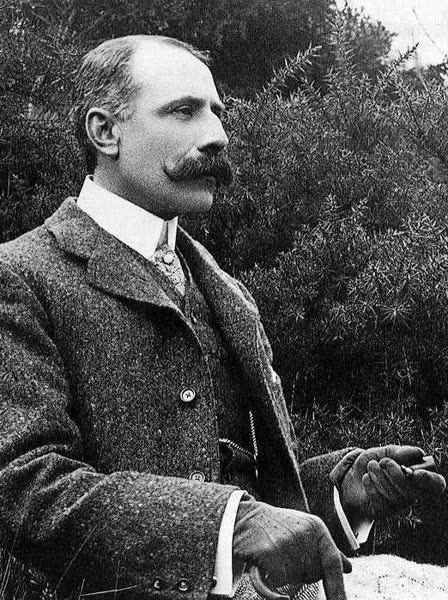
Edward Elgar was the first English composer in more than a century to win an international reputation, and his music - noble, warm, and tinged with melancholy - became the sound of Edwardian England. His Pomp and Circumstance March No. 1 is played at graduations around the world, but his deepest music is far more personal.
Life in brief
Elgar was born in 1857 near Worcester, in the west of England, the son of a piano tuner who ran a music shop. He was largely self-taught as a composer, learning from scores in his father's shop, and he spent years scraping a living as a violin teacher, freelance player, and even director of the staff band at a local mental hospital. As a Catholic from a modest background, he long felt an outsider in the class-bound world of English music.
In 1889 he married one of his pupils, Caroline Alice Roberts, the daughter of a major-general, whose family disapproved of the match. Alice believed in his genius and supported him completely; his little violin piece Salut d'amour was an engagement present to her. Success came late: the Enigma Variations (1899), written when he was 41, made his name almost overnight, and The Dream of Gerontius (1900) and the Pomp and Circumstance marches followed. He was knighted in 1904.
After Alice's death in 1920, he composed little more of importance. He was appointed Master of the King's Music, and became one of the first major composers to record his own works extensively. He died in Worcester in 1934, leaving sketches for a Third Symphony, later completed by Anthony Payne.
Music and style
Elgar's music combines the rich orchestration of the German Late Romantics - he admired Wagner and Brahms - with a distinctly English character: broad, singing melodies, ceremonial grandeur, and a pervasive wistfulness. He often marked his scores nobilmente ("nobly"), and that quality runs through his work alongside a quieter, more private sadness.
Key works
- Enigma Variations (1899) - fourteen variations, each a musical portrait of one of his friends, including the much-loved "Nimrod." Elgar hinted that a larger hidden theme runs through the whole work but never revealed it, and the puzzle is still debated. See theme and variations.
- Pomp and Circumstance March No. 1 (1901) - its trio melody became "Land of Hope and Glory."
- The Dream of Gerontius (1900) - an oratorio following a soul's journey after death.
- Symphony No. 1 (1908) - a huge success, performed around a hundred times in its first year.
- Violin Concerto (1910) and Cello Concerto (1919) - the second, an elegiac work written after the First World War, is one of the great cello concertos. See cello.
- Salut d'amour (1888) - a short, tender piece for violin and piano.
Legacy
Elgar restored English music's confidence and international standing, opening the way for Vaughan Williams, Holst, and Britten. His ceremonial music is woven into British public life, while the Cello Concerto and "Nimrod" are among the most loved works in the repertoire.
Where to start listening: "Nimrod" from the Enigma Variations is four minutes of noble, heartfelt music. Then try the first movement of the Cello Concerto, and the whole of the Enigma Variations.