Composer
Sergei Rachmaninoff
A late-blooming Romantic, writing lush, virtuosic piano music well into the 20th century.
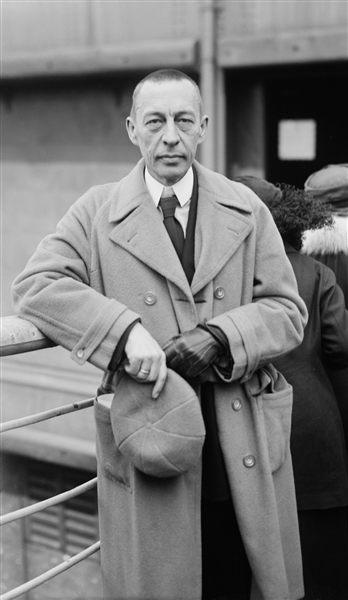
Sergei Rachmaninoff was a phenomenal concert pianist as well as a composer, and his own instrument dominates his output: some of the most demanding, lushly Romantic piano concertos ever written, composed and performed well after Debussy, Stravinsky, and Schoenberg had already begun pulling classical music toward modernism. Rachmaninoff, largely uninterested in those developments, kept writing in a late-Romantic idiom of sweeping melody and rich harmony almost until his death in 1943.
Life in brief
Rachmaninoff was born in 1873 into an aristocratic Russian family whose fortune was dwindling. He trained at the Moscow Conservatory, and shortly after graduating wrote a Prelude in C-sharp minor that became so popular that audiences demanded it at almost every concert he gave for the rest of his life - he came to refer to it wearily as "It."
Then came disaster. His First Symphony was savaged after a badly under-rehearsed premiere in 1897, and Rachmaninoff sank into a depression so deep that he barely composed for three years. With the help of the physician Nikolai Dahl, who treated him with a course of therapy and encouragement, he recovered - and the work that marked his comeback, the Piano Concerto No. 2, is dedicated to Dahl.
After the Russian Revolution of 1917, he left Russia with his family and never returned. To support them he rebuilt his career as one of the greatest touring pianists of the age, based mostly in the United States, and composed far less as a result. He became an American citizen only weeks before his death in Beverly Hills in 1943.
Music and style
Rachmaninoff's music is defined by long, aching melodies, rich and dark-hued harmony, and piano writing of enormous power and complexity. His hands were famously huge - he could reportedly span a thirteenth on the keyboard - and his piano parts reflect it, with dense chords spread across the instrument. A strain of Russian melancholy runs through everything, as does the sound of Russian church bells, which he loved from childhood.
His Piano Concerto No. 2 is one of the most popular concertos in the entire repertoire, prized for its combination of technical demand and overwhelming melodic and emotional weight. His Rhapsody on a Theme of Paganini, a set of variations on a famous violin melody by Paganini, is best known for its 18th variation - a melody so different from the theme it's built on that many listeners don't realize it's a variation at all. (It's the theme turned upside down.)
Key works
- Piano Concerto No. 2 (1901) - his comeback, and his most loved work.
- Piano Concerto No. 3 (1909) - one of the most fearsomely difficult concertos ever written, made famous to film audiences by Shine (1996).
- Rhapsody on a Theme of Paganini (1934).
- Prelude in C-sharp minor (1892) - the early piece that followed him everywhere.
- Symphony No. 2 (1907) - with one of his most heartfelt slow movements.
- All-Night Vigil (1915) - an unaccompanied choral setting of the Russian Orthodox service, often called his Vespers.
- Symphonic Dances (1940) - his last work.
Legacy
Critics in his own lifetime often dismissed Rachmaninoff as old-fashioned, but audiences never did, and his concertos are among the most performed in the world. His recordings as a pianist remain benchmarks, and his sweeping style has had a huge influence on film music - generations of movie romances owe something to the Second Concerto.
Where to start listening: the 18th variation of the Rhapsody on a Theme of Paganini is instantly recognizable and a good hook into his style; the Piano Concerto No. 2's opening movement rewards a full, patient listen.