Composer
Leonard Bernstein
Composer of West Side Story, star conductor, and America's great music teacher.
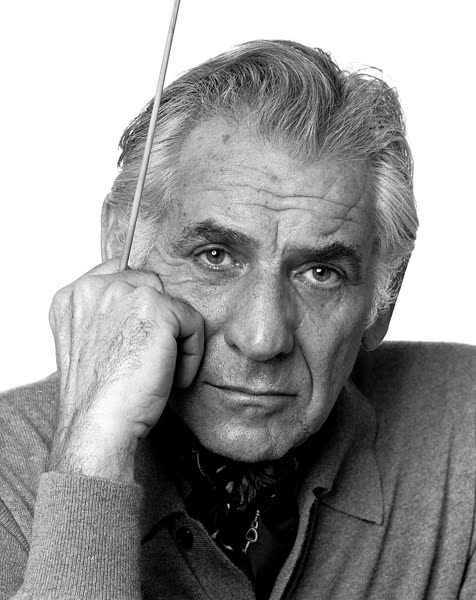
Leonard Bernstein was one of the most gifted and charismatic musicians of the 20th century: a composer who moved easily between Broadway and the concert hall, the first American-born music director of the New York Philharmonic, and, through television, a teacher who introduced millions of people to classical music.
Life in brief
Bernstein was born in 1918 in Lawrence, Massachusetts, the son of Jewish immigrants from Ukraine. He studied at Harvard and the Curtis Institute, and learned conducting from Serge Koussevitzky at the Tanglewood summer school.
In 1943, aged 25 and the New York Philharmonic's assistant conductor, he stepped in at a few hours' notice for the ailing guest conductor Bruno Walter, in a concert broadcast nationwide on radio. His triumph made front-page news and launched his career overnight. The following year he wrote the ballet Fancy Free and the hit musical On the Town.
From 1958 to 1969 he was music director of the New York Philharmonic, and his televised Young People's Concerts made him a household name. Meanwhile he composed the musicals Candide (1956) and West Side Story (1957), along with symphonies, choral music, and his theater piece MASS (1971). In his later years he conducted the world's great orchestras, and on Christmas Day 1989, weeks after the fall of the Berlin Wall, he led a celebrated performance of Beethoven's Ninth Symphony in Berlin, changing "Joy" in the "Ode to Joy" to "Freedom." He died in New York in 1990.
Music and style
Bernstein's music is energetic, theatrical, and eclectic, mixing the rhythms of jazz and Latin American dance with the harmony of Copland and Stravinsky, the melodic warmth of Broadway, and, in his concert works, Jewish liturgical music and themes of faith and doubt. As a conductor he was passionate and physical, and he championed the music of Mahler, helping to spark its revival in the 1960s.
Key works
- West Side Story (1957) - Romeo and Juliet on the streets of New York, with lyrics by Stephen Sondheim; songs include "Maria," "Tonight," and "America."
- Candide (1956) - an operetta after Voltaire, whose fizzing overture is a concert favorite.
- Chichester Psalms (1965) - joyful psalm settings in Hebrew for choir and orchestra.
- On the Town (1944) - his first Broadway hit, with "New York, New York."
- Symphonies - No. 1 "Jeremiah," No. 2 "The Age of Anxiety," and No. 3 "Kaddish."
- On the Waterfront (1954) - his only original film score.
- MASS (1971) - a theater piece written for the opening of the Kennedy Center in Washington.
Legacy
Few musicians have done more to bring classical music to a wide audience. Bernstein's television lectures are still watched, his recordings remain benchmarks, and West Side Story is one of the greatest of all musicals. See our guide to film scores versus classical music for more on music that crosses between worlds.
Where to start listening: the Symphonic Dances from West Side Story and the Candide overture are perfect introductions. Then try Chichester Psalms.