Composer
Domenico Scarlatti
The Italian who wrote 555 dazzling keyboard sonatas at the Spanish court.
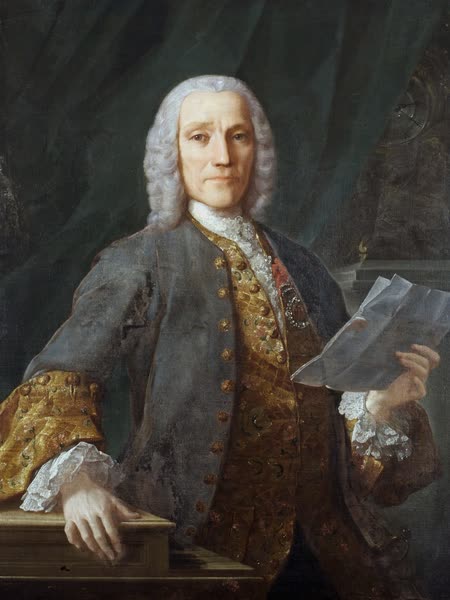
Domenico Scarlatti was born in the same year as Bach and Handel, but his path was utterly different. He spent the second half of his life at the royal courts of Portugal and Spain, where he poured his genius into more than 550 short keyboard sonatas - brilliant, witty, and full of the sounds of Spain.
Life in brief
Scarlatti was born in Naples in 1685, the sixth of ten children of Alessandro Scarlatti, one of the most celebrated opera composers in Italy. He grew up surrounded by music and spent his early career in his father's shadow, writing operas and church music in Naples, Venice, and Rome, where he worked for the exiled Polish queen Maria Casimira and as choirmaster at St. Peter's. A famous story, told by Handel's first biographer, says that the two young men had a friendly contest at the keyboard in Rome: they were judged equal on the harpsichord, but Handel was the better organist.
Around 1719 Scarlatti left Italy for Lisbon, where he became music master to the Portuguese royal family and teacher of the gifted young Princess Maria Barbara. When she married the heir to the Spanish throne in 1729, Scarlatti followed her to Spain. He spent the rest of his life in her service, in Seville and then Madrid, and she became queen in 1746. Almost all his sonatas seem to have been written for her and for himself to play. He died in Madrid in 1757.
Music and style
Most of Scarlatti's sonatas are single movements in two halves, each repeated, lasting three to six minutes. Within that simple frame he invented endlessly: rapid hand-crossings, leaps across the keyboard, fast repeated notes, crunching dissonant chords, and rhythms and melodic turns that echo Spanish guitars, castanets, and folk song. Many seem designed to be played in pairs. They were written for the harpsichord and the early fortepianos at the Spanish court, and today they are just as popular on the piano.
Only thirty were published in his lifetime, as the Essercizi per gravicembalo ("Exercises for harpsichord," 1738), with a preface urging players to enjoy the "ingenious jesting with art." The rest survive in manuscript copies made for the queen. They are usually identified by K. numbers, from the catalogue made by the American harpsichordist Ralph Kirkpatrick in 1953.
Key works
- Sonata in E major, K. 380 - a stately, ceremonial piece with horn calls, one of his most famous.
- Sonata in D minor, K. 141 - a showpiece of rapid repeated notes, like a guitar being strummed.
- Sonata in B minor, K. 27 - flowing and melancholy.
- Sonata in D minor, K. 9 - lyrical and graceful, nicknamed "Pastorale."
- Sonata in G minor, K. 30, the "Cat's Fugue," whose odd, leaping theme was said to have been suggested by a cat walking across the keyboard. See fugue.
- Stabat Mater - a richly woven setting for ten voices, from his years in Rome.
Legacy
Brahms collected copies of Scarlatti's sonatas, Bartók edited and performed them, and great 20th-century pianists such as Vladimir Horowitz made them concert favorites. They remain a staple of piano and harpsichord recitals, and a link between the Baroque and the lighter, brighter Classical style. See also the sonata.
Where to start listening: try the Sonata in E major, K. 380, then the dazzling D minor, K. 141. Listen to them on both harpsichord and piano: they sound remarkably different, and remarkably good, on each.