Composer
Georg Philipp Telemann
The most famous German composer of his day - and one of the most prolific in history.
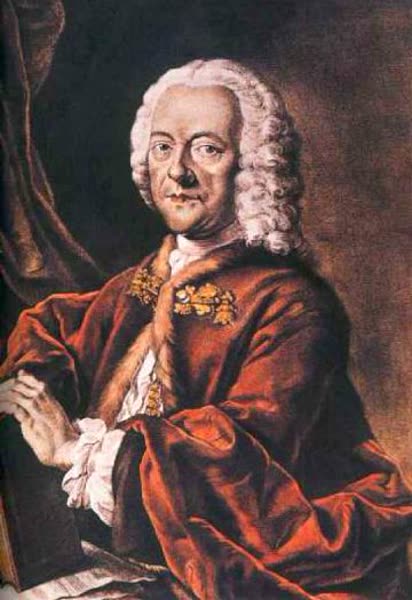
In his own lifetime, Georg Philipp Telemann was the most famous composer in Germany - far better known than his friend Johann Sebastian Bach. He was also one of the most prolific composers who ever lived, writing well over 3,000 works, and an astute businessman who published and sold his own music.
Life in brief
Telemann was born in Magdeburg in 1681 and was largely self-taught. His mother disapproved of a musical career and even confiscated his instruments, but he composed in secret. He went to Leipzig to study law, but music won out: he founded a student orchestra, the Collegium Musicum, wrote operas for the city's theater, and quickly became famous.
After posts at courts in Sorau and Eisenach and in the city of Frankfurt, in 1721 he became music director of the five main churches of Hamburg, one of the richest cities in Germany. He stayed for the rest of his life - over 45 years. In 1722 the city of Leipzig offered him its top musical job; Telemann used the offer to win a pay rise in Hamburg, and the Leipzig post went to Bach instead.
He was friends with both of the other great German composers of his generation: he was godfather to Bach's son Carl Philipp Emanuel, and he corresponded with Handel for decades, the two swapping news and exotic plants for their gardens. He worked to the end of his long life and died in Hamburg in 1767, aged 86. His godson C.P.E. Bach succeeded him.
Music and style
Telemann wrote in every genre of his day and absorbed every national style - German counterpoint, Italian melody, French elegance, and even Polish folk music, which he heard while working in Silesia. His music is fluent, tuneful, and inventive, often lighter and more immediately charming than Bach's, and he had a gift for writing music that amateurs could play and enjoy. He also wrote for unusual combinations of instruments and was among the first to write a concerto for the viola.
Key works
- Tafelmusik (1733) - "table music," three large collections of orchestral and chamber music.
- Viola Concerto in G major - one of the earliest concertos for the viola, and still a favorite.
- Paris Quartets - elegant chamber music for flute, violin, viola da gamba or cello, and continuo, written for Parisian virtuosos.
- Hamburger Ebb und Fluth ("Hamburg Ebb and Flow," 1723) - a suite of water music celebrating the city's port.
- Fantasias - sets of unaccompanied pieces for flute, violin, and harpsichord.
- Church music - more than a thousand cantatas.
Legacy
Telemann's reputation faded in the 19th century, when Bach's rose and his own sheer productivity was held against him. Today he is valued as one of the great composers of the late Baroque, and his music is a staple of period-instrument ensembles and amateur players alike.
Where to start listening: the Viola Concerto in G major is a perfect introduction - warm, graceful, and short. Then try a selection from Tafelmusik, or one of the Fantasias for solo flute.