Composer
Antonio Vivaldi
The Baroque violinist-composer who made the concerto tell a story.
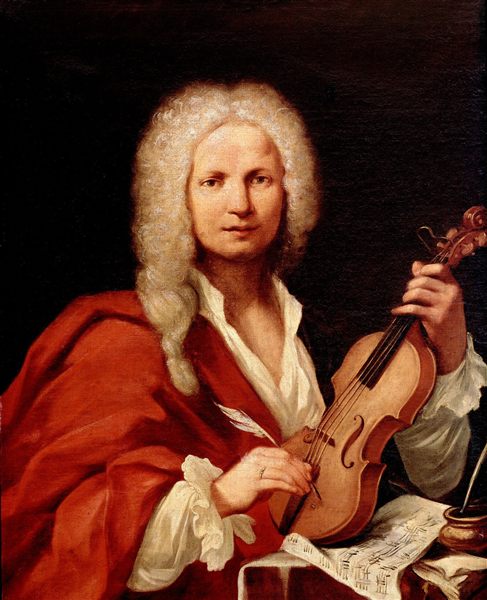
Antonio Vivaldi was a Venetian priest, virtuoso violinist, and prolific composer who spent much of his career teaching at a Venice orphanage for girls, writing a steady stream of music for its resident orchestra. He wrote hundreds of concertos, and did more than almost anyone to establish the concerto's signature format: a soloist set against the full ensemble, trading musical ideas in vivid contrast.
Life in brief
Vivaldi was born in Venice in 1678, the son of a violinist at St Mark's Basilica, who taught him to play. He trained for the priesthood and was ordained in 1703 - his red hair earned him the nickname il prete rosso, "the Red Priest" - but soon stopped saying Mass, citing a chronic chest ailment, probably asthma.
The same year he began working at the Ospedale della Pietà, a Venetian home for abandoned and orphaned girls whose musical training was famous across Europe. The girls' orchestra and choir performed behind ornate grilles, and visitors came from all over the continent to hear them. Vivaldi taught there, on and off, for most of his career, writing a constant supply of new music for them.
He was also an ambitious opera composer and impresario, and his published sets of concertos made him famous abroad - Bach arranged several of them for keyboard. But tastes changed. In 1740, he moved to Vienna, probably hoping for the patronage of Emperor Charles VI, who admired him; the emperor died soon after, and Vivaldi died in Vienna the following year, poor and largely forgotten.
Music and style
Vivaldi's music is instantly recognizable: driving rhythms, bright string textures, catchy themes, and dazzling solo violin writing. His concertos usually follow a fast-slow-fast pattern, with a recurring orchestral refrain (the ritornello) alternating with virtuoso solo passages. He could also write with great tenderness, especially in his slow movements and sacred vocal music.
His most famous work by far is The Four Seasons, a set of four violin concertos, each one paired with a poem (possibly written by Vivaldi himself) describing the season it depicts. The music follows the poetry closely - you can hear birdsong, storms, and ice underfoot - making it one of the earliest and most successful examples of clearly programmatic (story-telling) instrumental music, well over a century before the Romantic-era symphonic poem made that approach fashionable again.
Key works
- The Four Seasons (published 1725) - four violin concertos, one per season.
- L'estro armonico (1711) - a set of twelve concertos that spread his style across Europe.
- Gloria in D major - his joyful setting of the Gloria, his most popular sacred work.
- Stabat Mater - a deeply expressive setting of the medieval poem on Mary at the cross.
- Concertos for unusual instruments - mandolin, two cellos, bassoon (he wrote more than thirty bassoon concertos), and many more.
- Operas - around fifty, though only some survive complete.
Legacy
Vivaldi's music fell into obscurity for nearly two centuries after his death, and was only rediscovered and reassessed in the 20th century - a large collection of his manuscripts surfaced in Turin in the 1920s, and recordings of The Four Seasons in the decades after the Second World War made it a worldwide bestseller. He's now regarded as one of the most important and influential Baroque composers, especially for the concerto form, and The Four Seasons is one of the most recorded works in all of classical music.
Where to start listening: The Four Seasons - "Spring" in particular - is the friendliest, most immediately melodic entry point into Baroque music on this entire site. After that, the opening of the Gloria shows the same energy in choral form.