Instrument
Harpsichord
The piano's plucked-string ancestor, and the Baroque era's essential keyboard.
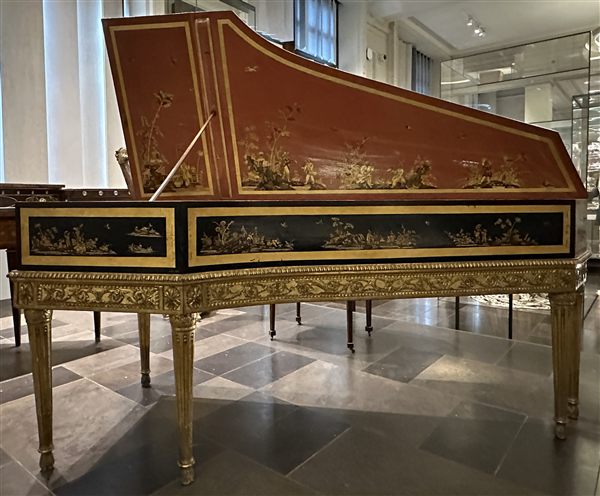
The harpsichord looks similar to a small grand piano, but works on an entirely different principle: pressing a key triggers a small plectrum (traditionally a bird quill) that plucks the string rather than a felt hammer striking it. That plucking mechanism means a harpsichordist can't control volume through touch the way a pianist can - pressing a key harder doesn't make it louder - which is the main limitation that eventually led to the piano's invention and gradual replacement of the harpsichord by the late 1700s.
Before that replacement, the harpsichord was the essential keyboard instrument of the Baroque era, central to basso continuo practice: a harpsichordist would realize the harmony underneath a piece in real time from a shorthand bass line, functioning as the rhythmic and harmonic glue of countless Baroque ensembles. Bach's solo keyboard works, including much of The Well-Tempered Clavier, were originally written with the harpsichord (or similar instruments) in mind, decades before the piano became widespread.
Where to start listening: any recording of Bach's Goldberg Variations played on harpsichord (rather than the more common modern piano recordings) shows the instrument's distinctive plucked timbre.