Composer
Barbara Strozzi
The Venetian singer who published more secular vocal music than almost anyone of her time.
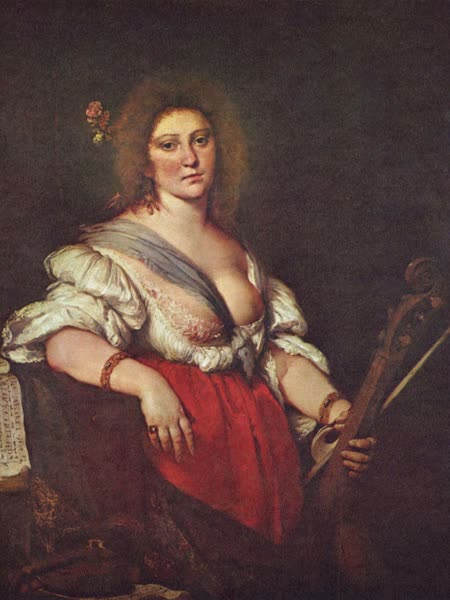
Barbara Strozzi was one of the most remarkable musicians of 17th-century Venice: a brilliant singer and a prolific composer who, unusually for a woman of her time, published her music under her own name. Her passionate songs for solo voice are among the finest of the early Baroque.
Life in brief
Strozzi was born in Venice in 1619. Her mother was a servant in the household of the poet and librettist Giulio Strozzi, who was very probably her father; he adopted her and made her his heir. Giulio was a leading figure in Venice's literary world, and he gave his daughter an exceptional education. She studied composition with Francesco Cavalli, a pupil of Monteverdi and the most successful opera composer in the city.
Giulio founded an academy of intellectuals, the Accademia degli Unisoni, which met at his house, and Barbara performed there as a singer and even set the topics for debate. Her prominence as a woman in a world of men drew admiration, and also mocking gossip.
She never married, but had four children, at least three of them probably with a nobleman, Giovanni Paolo Vidman. Between 1644 and 1664 she published eight volumes of music, dedicating them to wealthy patrons in the hope of support. She died in Padua in 1677.
Music and style
Strozzi wrote almost entirely for the voice, mostly for solo soprano - likely her own voice - accompanied by the basso continuo of a harpsichord, lute, or cello. Her arias and cantatas are dramatic and deeply expressive, full of sighs, sudden silences, dissonances that ache, and long, virtuosic melodies. She was a master at painting the words, and many of her songs are about the pain and absurdity of love. Her vocal writing is closely linked to the new world of Venetian opera, though she wrote no operas herself.
Key works
- "Che si può fare" (1664) - "What can be done?", a lament over a slowly repeating bass line, perhaps her most famous piece.
- "Lagrime mie" (1659) - "My tears," a searing cantata of grief at a lover's imprisonment.
- "L'Eraclito amoroso" (1651) - a lament built over a descending bass, in which the singer, like the weeping philosopher Heraclitus, can only cry.
- "Sino alla morte" (1659) - "Until death," a long, dramatic cantata.
- Il primo libro de' madrigali (1644) - her first publication, of madrigals for two to five voices with texts by her father.
Legacy
Strozzi published more secular vocal music than almost any other composer of her era, a remarkable achievement in a world that gave women little room to compose. Forgotten for centuries, her music has been revived by singers since the late 20th century, and it is now a staple of Baroque song recitals. See also Hildegard von Bingen and Clara Schumann.
Where to start listening: "Che si può fare," then "Lagrime mie," ideally with the text in front of you to follow how closely the music follows the words.