Composer
Jean-Philippe Rameau
The great music theorist who wrote his first opera at fifty - and changed French music.
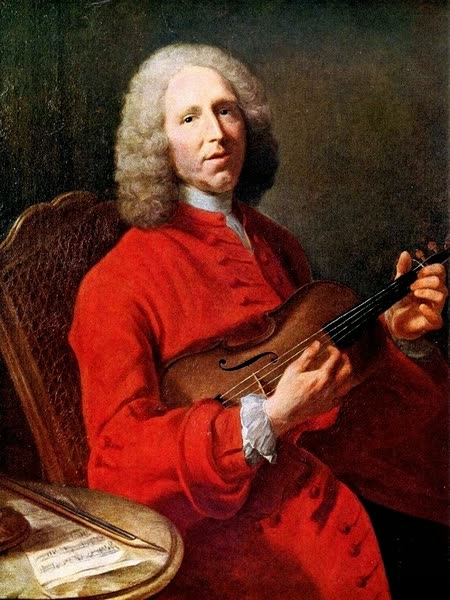
Jean-Philippe Rameau was both the leading music theorist of the 18th century and the greatest French opera composer after Lully. Yet he was almost fifty, and known mainly as a theorist and organist, before his first opera reached the stage. His operas are full of daring harmony, brilliant orchestral color, and some of the most exhilarating dance music of the Baroque era.
Life in brief
Rameau was born in Dijon in 1683, the son of an organist. He spent his early career as an organist in provincial cathedrals and churches, in Clermont, Dijon, and Lyon, and published his first book of harpsichord pieces in 1706.
In 1722 he published his Treatise on Harmony, a groundbreaking book that explained harmony as a system built on chords and their roots, and it made his name. He settled in Paris, where he found a wealthy patron, the financier La Pouplinière, who gave him an orchestra to work with. In 1733, at the age of fifty, he produced his first opera, Hippolyte et Aricie. It caused a sensation, and a furious controversy: supporters of Lully's tradition attacked it as noisy and overcomplicated, while others hailed a new genius.
Rameau wrote some thirty works for the stage, became court composer to Louis XV, and remained combative to the end. In the 1750s he was drawn into the "Quarrel of the Buffoons," in which the philosopher Jean-Jacques Rousseau and others championed light Italian comic opera against French tradition. He died in Paris in 1764.
Music and style
Rameau's music is bold and colorful. His harmony is richer and more daring than Lully's, his orchestration vivid and inventive, with prominent woodwinds and dramatic descriptive passages: storms, earthquakes, birdsong, and even a croaking chorus of frogs. His dances - gavottes, tambourins, chaconnes, and more - are irresistibly rhythmic, and his harpsichord pieces are witty and picturesque.
His theories, describing chords as built from stacked thirds and recognizing that a chord keeps its identity when its notes are rearranged, became the foundation of harmony as it is still taught today.
Key works
- Les Indes galantes (1735) - an opera-ballet of love stories set in exotic lands, including the famous dance of the "Savages." See ballet music.
- Hippolyte et Aricie (1733) - his explosive operatic debut.
- Castor et Pollux (1737) - a tragedy of brotherly love, with the haunting aria "Tristes apprêts."
- Platée (1745) - a hilarious comic opera about a vain, ugly water nymph who believes Jupiter loves her.
- Pièces de clavecin - harpsichord pieces such as "Le Rappel des oiseaux" ("The Call of the Birds"), "La Poule" ("The Hen"), and "Tambourin." See harpsichord.
- Treatise on Harmony (1722) - one of the most influential books in the history of music theory.
Legacy
Rameau's theories shaped music education for centuries, and his operas, long neglected, have been triumphantly revived by period-instrument ensembles. Debussy admired him enormously and called for a return to his clarity and grace. See also opera and Couperin.
Where to start listening: "Les Sauvages" from Les Indes galantes, then "La Poule" for harpsichord, and the croaking frogs of Platée.