Composer
Jean-Baptiste Lully
The Italian-born dancer who ruled music at the court of Louis XIV.
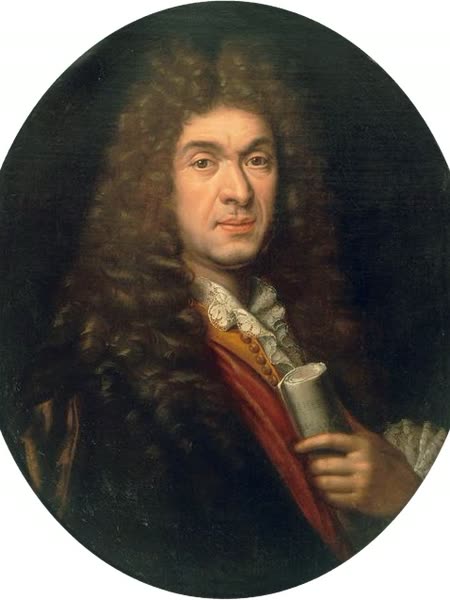
Jean-Baptiste Lully was the most powerful musician of 17th-century France. A miller's son from Florence, he rose to dominate music at the court of Louis XIV, the Sun King, and created a new national form, French opera, that would last for a century. He was also ambitious, ruthless, and scandalous - and he died from a wound he gave himself while conducting.
Life in brief
Lully was born Giovanni Battista Lulli in Florence in 1632. At about thirteen he was brought to Paris to serve a cousin of the young king as a page and Italian conversation partner, and there he learned the violin and dancing so well that he came to the notice of the court. In 1653 he danced alongside the fourteen-year-old Louis XIV in a lavish court ballet, and soon afterwards he was appointed royal composer of instrumental music.
He became a French citizen, rose to the highest musical post at court, and worked with the playwright Molière on a series of "comedy-ballets," mixing spoken drama, music, and dance. In 1672 he bought the royal privilege to present opera in France, a monopoly he guarded fiercely, and with the poet Philippe Quinault he created a series of tragedies in music that defined French opera.
In January 1687, conducting a Te Deum to celebrate the king's recovery from illness, he beat time by striking the floor with a long staff, and hit his own foot. The wound turned to gangrene, he refused to have his toe amputated, and he died in March.
Music and style
Lully shaped music to the French language and to the grandeur of the court. His operas combine expressive, speech-like recitative, closely following the rhythms of French verse, with choruses, spectacular staging, and above all dance. He trained his court orchestra, the Vingt-quatre Violons du Roi (Twenty-Four Violins of the King) and the smaller Petits Violons, to play with unprecedented discipline and unity.
He also established the French overture: a slow, majestic opening with jagged dotted rhythms, followed by a fast section in imitation. Composers across Europe, including Handel and Bach, adopted it. See overture.
Key works
- Le Bourgeois gentilhomme (1670) - his most famous comedy-ballet with Molière, about a social climber who wants to be a gentleman.
- "March for the Turkish Ceremony" - the mock-ceremonial march from Le Bourgeois gentilhomme. See march.
- Atys (1676) - known as "the King's opera," for Louis XIV's love of it.
- Alceste (1674) - an early tragedy in music on the myth that later inspired Gluck.
- Armide (1686) - often considered his masterpiece.
- Te Deum (1677) - a grand choral work, and the piece he was conducting when he injured himself.
Legacy
Lully's model of French opera, with its dances, choruses, and declamation, shaped French music until Rameau and beyond, and his orchestral discipline influenced orchestras across Europe. See also opera, ballet music, and the Baroque era.
Where to start listening: the "March for the Turkish Ceremony," then the overture and dances from Le Bourgeois gentilhomme, and highlights of Atys.