Instrument
Classical Guitar
Six nylon strings, plucked by the fingers - the intimate voice of Spain and beyond.
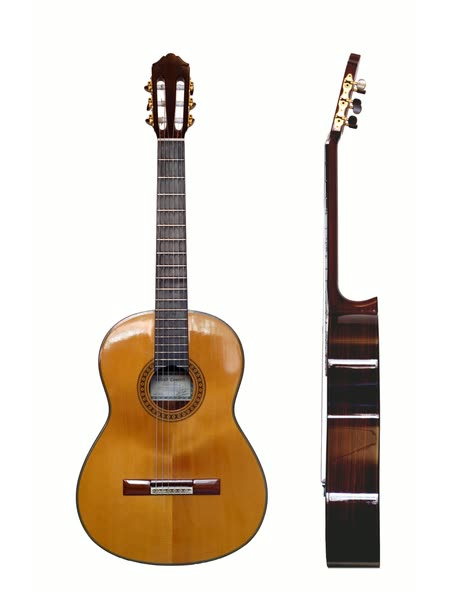
The classical guitar is a six-string instrument with a hollow wooden body, played by plucking the strings with the fingers. Its strings are made of nylon rather than steel, giving it a softer, warmer, rounder tone than the acoustic guitars of folk and pop. It is above all a solo instrument, with a rich repertoire stretching from the Renaissance to today, and it is closely associated with Spain.
How it's played
The six strings are tuned E-A-D-G-B-E, from low to high. The player's left hand presses the strings against metal frets on the neck to change the notes, while the right hand plucks with the fingertips and fingernails, never with a pick. This lets a single guitarist play melody, bass, and harmony at the same time, and produce a remarkable range of colors: playing near the bridge gives a bright, metallic sound, while playing over the soundhole gives a sweet, mellow one. Classical guitarists traditionally sit, with the instrument resting on the left leg, often raised on a small footstool.
Ancestors and history
The guitar's relatives were played across Europe in the Renaissance, especially in Spain, where the vihuela, a guitar-shaped instrument tuned like a lute, had a golden age of music in the 16th century. The five-course Baroque guitar was popular in Spain, Italy, and France in the 17th century.
The six-string guitar emerged around 1800, and virtuosos such as the Spaniard Fernando Sor and the Italian Mauro Giuliani wrote much of its early concert music. In the mid-19th century the Spanish maker Antonio de Torres designed a larger body with a fan-shaped pattern of internal bracing, creating the modern classical guitar. The composer and guitarist Francisco Tárrega built a new repertoire and technique for it, and in the 20th century the great Spanish guitarist Andrés Segovia carried it into the world's concert halls, commissioning new works from many composers.
Essential classical guitar music
- Joaquín Rodrigo - Concierto de Aranjuez (1939) - the most famous guitar concerto, whose slow movement melody is introduced by the English horn.
- Francisco Tárrega - Recuerdos de la Alhambra (1896) - a shimmering tremolo study, in which rapid repeated notes sound like a continuous melody.
- Isaac Albéniz - Asturias - written for piano, but far better known in its fiery guitar arrangement.
- Heitor Villa-Lobos - Five Preludes and Twelve Études - Brazilian classics of the 20th-century repertoire.
- Britten - Nocturnal after John Dowland (1963) - written for the English guitarist Julian Bream.
- Bach - Lute Suites and Cello Suites, often played on the guitar in arrangements.
Where to start listening: the Adagio from the Concierto de Aranjuez, then Recuerdos de la Alhambra. Great guitarists to explore include Segovia, Julian Bream, and the Australian guitarist John Williams - no relation of the film composer. See also the harp, another plucked string instrument.