Instrument
Recorder
Much more than a school instrument - the flute of the Renaissance and Baroque.
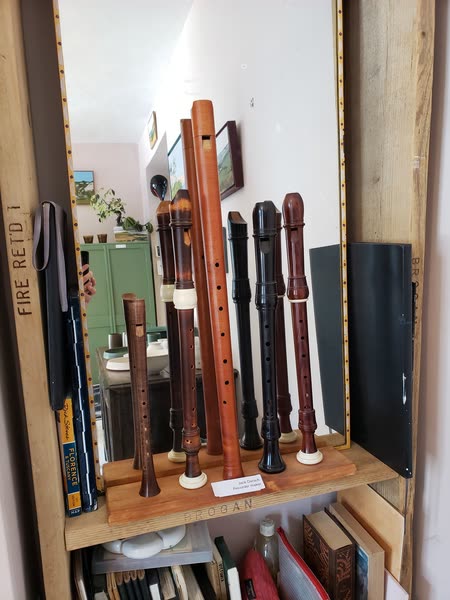
For many people the recorder is the plastic instrument they first played at school. But it has a long and distinguished history as a serious concert instrument: in the Renaissance and Baroque, it was simply called the "flute," and composers including Bach, Handel, Vivaldi, and Telemann wrote beautiful music for it.
How it works
The recorder is an end-blown flute: the player blows into a mouthpiece at the top, which directs the air through a narrow channel against a sharp edge, just like a whistle. Notes are changed by covering seven finger holes on the front and a thumb hole on the back. Because the mouthpiece shapes the air for the player, it is easy to make a first sound - which is why it is used in schools - but playing it well, with a beautiful tone, perfect tuning, and expressive control, is genuinely difficult. Recorders are traditionally made of wood such as boxwood, maple, or pearwood.
The recorder family
Recorders come in a whole family of sizes, from the tiny garklein and the sopranino to the soprano (or descant), alto (or treble), tenor, and bass, and even larger great bass and contrabass instruments. The alto is the main solo instrument of the Baroque, while Renaissance music was often played by a consort, a matched set of recorders of different sizes playing together, like a choir.
A short history
Recorders were played in Europe by the 14th century, and they flourished in the Renaissance, when no well-equipped court was without a chest of them. In the Baroque era the instrument was redesigned in several jointed sections, with a sweeter tone and a wider range, and it became a favorite solo instrument. But from the mid-18th century the louder, more flexible transverse flute took over, and the recorder all but disappeared.
It was revived in the 20th century, led by the instrument maker Arnold Dolmetsch in England, who began making recorders based on historical models around 1920. Cheap plastic recorders made it a classroom staple, and virtuosos such as Frans Brüggen and Michala Petri showed what it could really do, inspiring a large modern repertoire.
Essential recorder music
- Bach - Brandenburg Concertos Nos. 2 and 4, which feature recorders as soloists. See concerto.
- Vivaldi - Recorder concertos, including the virtuosic concertos for the tiny sopranino recorder.
- Telemann - Suite in A minor and Concerto for recorder and viola da gamba.
- Handel - Recorder sonatas, among his most charming chamber works.
- Jacob van Eyck - Der Fluyten Lust-hof (1640s–1650s) - a huge collection of variations for solo recorder by a blind Dutch carillon player.
- Bach - Cantata No. 106, Actus tragicus, opening with two recorders in a tender sonatina.
Where to start listening: the first movement of Bach's Brandenburg Concerto No. 4, then a Vivaldi concerto for sopranino recorder. See also the Baroque era and the woodwind family.