Instrument
Bassoon
A double-reed woodwind pitched an octave and more below the oboe.
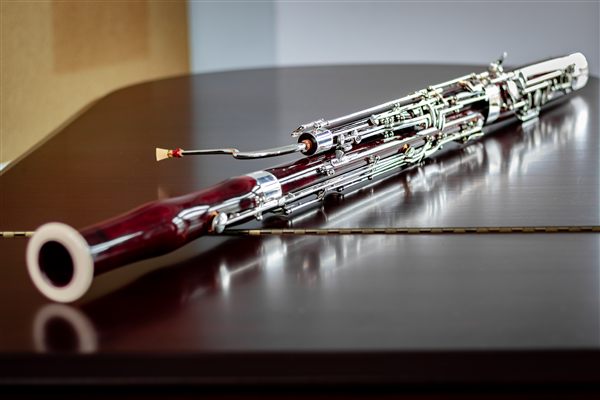
The bassoon is the woodwind family's bass voice, sharing the oboe's double-reed mechanism but pitched far lower - low enough that its roughly eight feet of tubing has to be doubled back on itself to keep the instrument a manageable size to hold and play.
Its tone can shift character dramatically depending on register and context: reedy and somewhat comic in its middle range (composers have long exploited this for lighthearted or grotesque effect), but warm and genuinely lyrical lower down, capable of real melodic expressiveness rather than purely harmonic support.
Structurally, the bassoon is built in four detachable sections - the wing joint, boot joint, long joint, and bell - a design that lets its folded tubing (and the roughly 20-plus tone holes and keys covering it) be manufactured and repaired in manageable pieces rather than as one unwieldy tube. It descends from the Renaissance and early Baroque dulcian (also called the curtal), a simpler single-piece double-reed instrument with the same folded-bore idea, refined into something closer to the modern bassoon over the 18th century. Among orchestral instruments its range is unusually wide, running from a deep bass register up into a reedy tenor range, which is part of why composers can use it as both harmonic foundation and solo voice within the same piece.
Where to start listening: the opening bassoon solo of Stravinsky's The Rite of Spring, pushed into an unusually high, strained register, is one of the most famous (and most difficult) bassoon passages ever written. For its lighter, more comic side, the bassoon's role as the grandfather's grumbling theme in Prokofiev's Peter and the Wolf shows exactly the character composers reach for it to supply.