Instrument
Bass Clarinet
The clarinet's deep, velvety big brother - an octave lower and full of mystery.
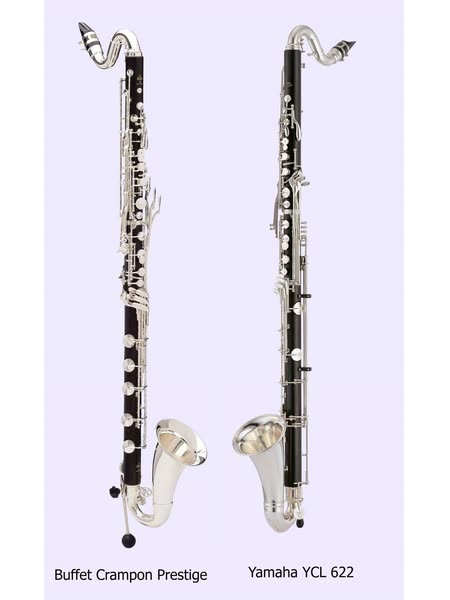
The bass clarinet is the larger, lower relative of the clarinet, pitched an octave below the standard B-flat instrument. Its tone is dark, warm, and velvety in the low register, and composers use it for moments of mystery, gloom, menace, and humor.
How it's built and played
The bass clarinet works exactly like the ordinary clarinet: the player blows through a mouthpiece with a single cane reed, and changes notes with the same system of keys and fingerings. But it is far too long to hold straight, so its body is fitted with a curved metal neck at the top, bringing the mouthpiece to the player's lips, and an upturned metal bell at the bottom. The result looks a little like a straight saxophone, and the instrument usually rests on the floor on a peg or stand.
Most modern bass clarinets reach down to a low C (written), which sounds a B-flat more than two octaves below middle C - deep enough to underpin the whole woodwind section. In most orchestras it is played by a clarinetist who specializes in it, or who switches between the clarinet and bass clarinet during a concert.
A short history
Instrument makers experimented with low clarinets throughout the 18th century, but the modern bass clarinet took shape in the 1830s, when the Belgian maker Adolphe Sax - later the inventor of the saxophone - greatly improved its design. Composers soon took notice. Giacomo Meyerbeer gave it a famous solo in his opera Les Huguenots (1836), and Wagner, Liszt, and Tchaikovsky used it for its dark, brooding color. By the 20th century it had become a regular member of the large orchestra.
Famous bass clarinet moments
- Tchaikovsky - "Dance of the Sugar Plum Fairy" from The Nutcracker, where the bass clarinet answers the celesta with deep, gurgling descending runs.
- Tchaikovsky - Symphony No. 6, "Pathétique," first movement, where a famous dying-away phrase marked pppppp for bassoon is often played on the bass clarinet.
- Wagner - Tristan und Isolde, Act 2, where it shadows King Mark's grief-stricken monologue.
- Stravinsky - The Rite of Spring, which uses two bass clarinets for its primeval, earthy textures.
- Shostakovich - symphonies and film scores, which often give it sardonic, grotesque solos.
- Steve Reich - Music for 18 Musicians, where two bass clarinets play long, breathing pulses that give the piece its warmth.
Beyond the orchestra
The bass clarinet also found a home in jazz, above all through the virtuoso Eric Dolphy in the 1960s, and it is a staple of the concert band and of contemporary music, where players explore its huge range of sounds, from whispery breath tones to rapid, bubbling arpeggios.
Where to start listening: the "Dance of the Sugar Plum Fairy," listening for the bass clarinet's dark replies to the celesta. Then try the opening of Music for 18 Musicians. See also the woodwind family.