Instrument
Viola da Gamba
The "leg viol" - a fretted, bowed instrument with a gentle, singing voice.
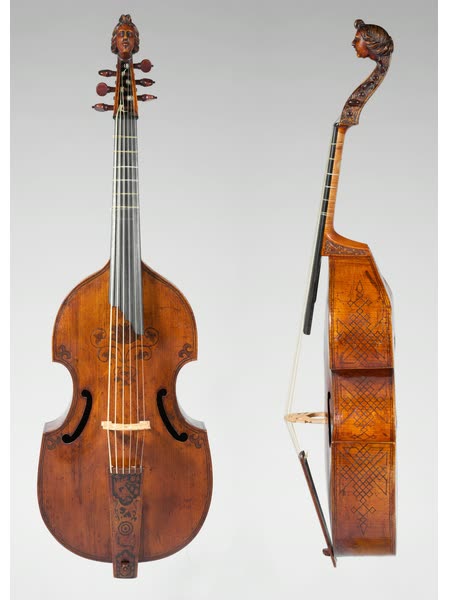
The viola da gamba, or viol, is a bowed string instrument held upright between the player's legs - its name is Italian for "viol of the leg." It looks a little like a cello, but it belongs to a different family, with its own sound and history. For two centuries it was one of the most important instruments in Europe, prized for its soft, resonant, almost vocal tone.
How it differs from the cello
The viol has several features that set it apart from the violin family:
- Six strings (sometimes seven), tuned mostly in fourths, like a lute, rather than the cello's four strings tuned in fifths.
- Frets of gut tied around the neck, like a lute or guitar, which give its notes a clear, ringing quality.
- Underhand bowing: the bow is held with the palm facing up, and the strongest stroke is the push rather than the pull.
- A flat back, sloping shoulders, and thinner wood, making it lighter and more resonant but quieter than the cello.
Viols came in a family of sizes - treble, tenor, and bass - and even the smallest are played upright on or between the knees. The bass viol, roughly the size of a cello, was the most important solo instrument.
Consorts and courts
The viol emerged in Spain in the late 15th century and spread across Europe in the Renaissance. In England, music for a consort of viols - a matched set of different sizes playing together - became a great tradition, with fantasias and dances by William Byrd, Orlando Gibbons, John Dowland, and, at the very end of the era, Purcell. See fantasia and chamber music.
In France, the bass viol became a virtuoso solo instrument at the court of Louis XIV. Marin Marais, a pupil of the legendary player Monsieur de Sainte-Colombe, published five books of exquisite pieces for viol, and their story inspired the 1991 film Tous les matins du monde, which brought the instrument to a wide audience.
Bach and the end of an era
In Germany, Bach gave the viol some of its most moving moments: the aria "Es ist vollbracht" ("It is finished") in the St. John Passion features a solo gamba, and he wrote three sonatas for gamba and harpsichord. The last great virtuoso, Carl Friedrich Abel, played in London in the 1760s and 1770s. By then the louder cello had won the day, and the viol fell silent until early-music players revived it in the 20th century, led by performers such as Jordi Savall.
Essential viol music
- Marin Marais - Pièces de viole - including the tender "Les Voix humaines" and the bell-ringing "Sonnerie de Sainte-Geneviève du Mont-de-Paris."
- Bach - "Es ist vollbracht" from the St. John Passion.
- Bach - Sonatas for Viola da Gamba and Harpsichord.
- Purcell - Fantasias for viols.
- John Dowland - Lachrimae, or Seaven Teares - for viols and lute.
Where to start listening: a piece by Marin Marais played by Jordi Savall, then "Es ist vollbracht." See also the lute and the Baroque era.