Instrument
Saxophone
A brass instrument that's really a woodwind - and a star of jazz and the concert hall.
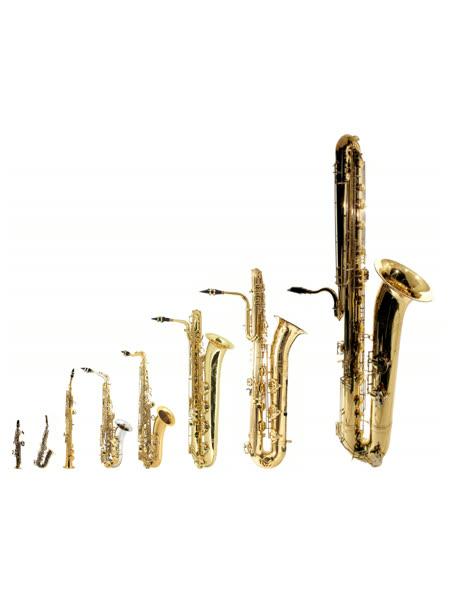
The saxophone is one of the youngest instruments in common use, invented in the 1840s by the Belgian instrument maker Adolphe Sax. Although its body is made of brass, it's a woodwind: it makes its sound with a single reed, like a clarinet. It became a giant of jazz and popular music - and has a smaller but fascinating place in classical music.
How it works
The player blows into a mouthpiece with a single cane reed, and changes notes by pressing keys that open and close holes along a cone-shaped brass tube. That combination gives the saxophone a sound between woodwind and brass: flexible and expressive, but powerful and full. Sax deliberately designed it to bridge the two families, and he patented it in Paris in 1846.
The saxophone family
Sax built a whole family of saxophones in different sizes, as the photo above shows. The four most common are the soprano, alto, tenor, and baritone, and together they form the classic saxophone quartet. Sizes range from the tiny sopranino to the enormous contrabass. Like the clarinet, saxophones are transposing instruments.
In the orchestra
Sax hoped his instrument would join the symphony orchestra, but it never became a regular member - by the time it arrived, the orchestra's woodwind section was already established. Military bands adopted it eagerly, and composers have borrowed it for special colors ever since:
- Bizet - L'Arlésienne (1872) - a famous, melancholy alto saxophone solo.
- Mussorgsky, orchestrated by Ravel - "The Old Castle" from Pictures at an Exhibition, a haunting alto saxophone song.
- Ravel - Boléro, where saxophones take turns with the melody.
- Rachmaninoff - Symphonic Dances, with a long, wistful alto saxophone solo.
- Prokofiev - Romeo and Juliet, which uses a tenor saxophone.
- Gershwin - An American in Paris, with three saxophones adding jazzy color.
Concertos and soloists
The saxophone also has a concert repertoire of its own. In the early 20th century, an American amateur player, Elise Hall, commissioned works from French composers including Debussy, whose Rapsodie for saxophone and orchestra resulted. Alexander Glazunov's Saxophone Concerto (1934) and Jacques Ibert's Concertino da camera are cornerstones, and players such as Marcel Mule helped establish the saxophone as a serious classical solo instrument.
Jazz and beyond
The saxophone found its greatest fame in jazz, through players such as Coleman Hawkins, Charlie Parker, and John Coltrane, and it became a staple of big bands, rock, and pop. Adolphe Sax himself saw little of that success: he was plagued by lawsuits from rival instrument makers, went bankrupt more than once, and died poor in 1894.
Where to start listening: "The Old Castle" from Ravel's orchestration of Pictures at an Exhibition is a beautiful introduction to the saxophone's classical voice. Then try the saxophone solo in the first movement of Rachmaninoff's Symphonic Dances. See also the woodwind family.