Instrument
Contrabassoon
The lowest voice of the woodwinds - a bassoon an octave deeper.
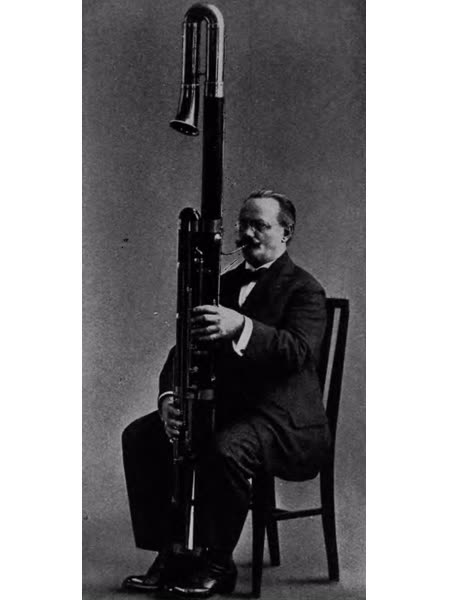
The contrabassoon, also called the double bassoon, is the lowest instrument of the woodwind section, sounding an octave below the bassoon. Its deepest notes reach down to the bottom of the piano keyboard, and its sound - a dark, buzzing growl - adds weight and depth to the whole orchestra.
How it's built and played
Like the bassoon, the contrabassoon is a double-reed instrument: the player blows through two thin blades of cane bound together, which vibrate against each other. Its conical tube is roughly twice as long as the bassoon's, more than five meters in total, so it is folded back on itself several times to make it manageable. Even so, the instrument stands taller than a seated player and rests on the floor on a spike. Its metal bell usually points downward.
Playing it takes a great deal of breath and careful control, and its low notes are slow to speak, so composers rarely give it fast passages. In most orchestras it is played by a bassoonist who specializes in it, sometimes switching between bassoon and contrabassoon in the same concert.
A short history
Contrabassoons were being built by the early 18th century, and composers used them to strengthen the bass in large works: Haydn called for one in his oratorio The Creation (1798). But early instruments were clumsy and often out of tune. The modern contrabassoon was developed in the late 19th century by the German maker Heckel, whose design gave it a reliable, focused tone, and from then on it became a standard member of the large orchestra.
Famous contrabassoon moments
- Beethoven - Symphony No. 5, finale, where it joins the piccolo and trombones in Beethoven's enlarged orchestra.
- Beethoven - Symphony No. 9, finale, where it grunts out the opening of the "Turkish" march with the bassoons and bass drum.
- Brahms - Symphony No. 1, adding darkness to the orchestra's lowest notes.
- Ravel - Mother Goose, where the contrabassoon is the voice of the Beast in "Conversations of Beauty and the Beast."
- Ravel - Piano Concerto for the Left Hand, which opens with a mysterious contrabassoon solo rising from the depths.
- Paul Dukas - The Sorcerer's Apprentice, where it helps bring the enchanted broomstick to life, famous from Disney's Fantasia.
Where to start listening: "Conversations of Beauty and the Beast" from Ravel's Mother Goose is the contrabassoon's most charming role. Then listen for its growl at the very start of Ravel's Left Hand Concerto. See also the woodwind family.