Instrument
Celesta
A keyboard that rings like tiny bells - the sound of the Sugar Plum Fairy.
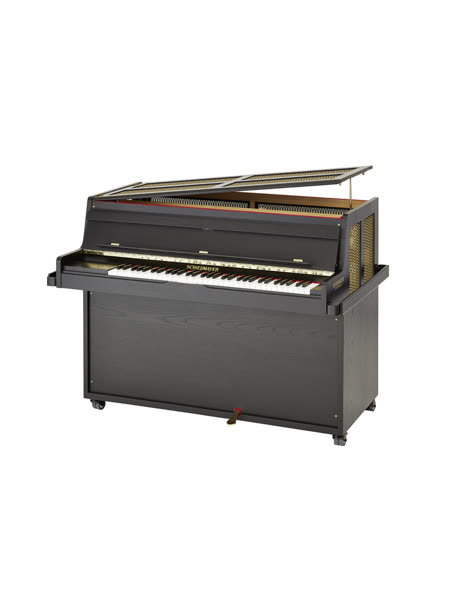
The celesta looks like a small upright piano, but it sounds like a music box or a set of tiny, sweet-toned bells. Its name comes from the French céleste, "heavenly," and that's exactly how it sounds: delicate, shimmering, and a little magical. Its most famous moment is the "Dance of the Sugar Plum Fairy" in Tchaikovsky's The Nutcracker.
How it works
Pressing a key works a hammer mechanism much like a piano's, but instead of strings, the felt hammers strike small steel plates, each mounted over a wooden resonator that amplifies its soft, bell-like ring. A sustain pedal lets the notes ring on. The celesta is quiet - it can easily be drowned by the orchestra - and composers use it for moments of transparency and wonder. It is usually played by the orchestra's keyboard player, and although it has keys, orchestras treat it as part of the percussion section.
Tchaikovsky's secret
The celesta was invented by the Parisian instrument maker Auguste Mustel, who patented it in 1886. Tchaikovsky heard one in Paris in 1891 and was enchanted. He arranged for one to be sent to Russia and asked his publisher to keep it a secret, worried that rival composers such as Rimsky-Korsakov might use it before him. The following year it made its famous appearance as the voice of the Sugar Plum Fairy in The Nutcracker (1892). See ballet music.
Playing the celesta
Because it sounds an octave higher than written and fades quickly, the celesta is often used to double a melody played by flutes, harp, or glockenspiel, adding sparkle rather than carrying a tune alone. It is easily confused with the glockenspiel, which also uses metal bars, but the glockenspiel is struck directly with mallets and has a harder, brighter ring; the celesta's felt hammers and resonators give it a softer, rounder, more magical tone.
Magical moments
Since then, composers have used the celesta to conjure the otherworldly:
- Tchaikovsky - "Dance of the Sugar Plum Fairy," The Nutcracker (1892).
- Holst - "Neptune, the Mystic," from The Planets, fading into infinite space.
- Bartók - Music for Strings, Percussion and Celesta (1936), which names the instrument in its title.
- Richard Strauss - Der Rosenkavalier, the glittering "Presentation of the Rose."
- Ravel - Boléro, where the celesta joins a horn and two piccolos in an eerie, organ-like blend.
- Mahler - Das Lied von der Erde, its final song dissolving into celesta chords.
- John Williams - "Hedwig's Theme," the Harry Potter theme that opens with a solo celesta.
Where to start listening: the "Dance of the Sugar Plum Fairy" is the celesta's signature piece - listen for its sparkling, music-box sound. Then hear it open "Hedwig's Theme," and fade into silence at the end of Holst's "Neptune."