Instrument
Vibraphone
Metal bars and spinning fans - the shimmering, dreamy voice of jazz and modern music.
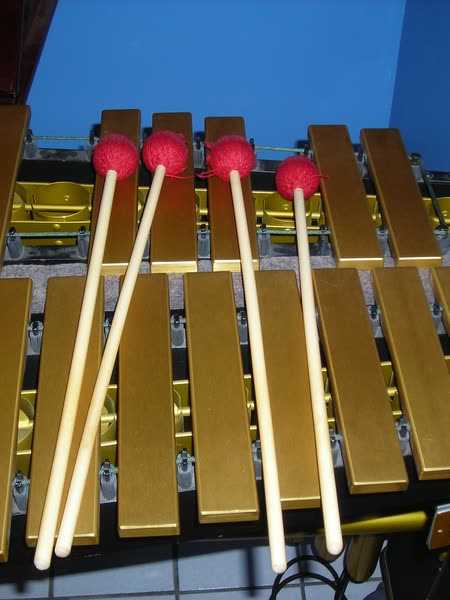
The vibraphone, often called the vibes, is a percussion instrument with metal bars laid out like a piano keyboard, struck with soft mallets. Its sound is mellow, ringing, and dreamy, and its special trick is a gentle, pulsing vibrato produced by spinning fans inside its resonators. Invented in the United States in the 1920s, it became a star of jazz and a favorite color of 20th-century composers.
How it works
The vibraphone's bars are made of aluminum, and like the marimba, each has a tube-shaped resonator hanging beneath it. At the top of each resonator is a small disc, or fan; all the fans are linked to a rod turned by an electric motor. As they spin, they open and close the resonators, making the sound swell and fade rapidly - the vibraphone's famous shimmer. The motor's speed can be changed, or switched off altogether for a pure, steady tone.
Unlike the xylophone and marimba, the vibraphone has a sustain pedal, like a piano's: when the pedal is down, the notes ring on; when it is up, felt dampers silence them. Players often hold four mallets, two in each hand, to play chords, and use the pedal and techniques such as damping individual bars with a mallet to shape their phrases.
A jazz instrument
The vibraphone was developed by American percussion makers in the 1920s, and it was soon taken up by jazz musicians. Lionel Hampton made it famous in the 1930s, playing with the Benny Goodman Quartet; Milt Jackson of the Modern Jazz Quartet gave it a cool, bluesy voice; and Gary Burton developed dazzling four-mallet techniques. It remains a central jazz instrument today.
The vibraphone in classical music
Composers quickly discovered its haunting colors. Alban Berg used it in his opera Lulu (1937), one of its first appearances in an opera, and Messiaen gave it a prominent role in the Turangalîla-Symphonie. Pierre Boulez featured it in Le Marteau sans maître (1955), and in Steve Reich's Music for 18 Musicians the vibraphone plays the signals that tell the ensemble when to move to the next section.
Famous vibraphone music
- Steve Reich - Music for 18 Musicians - the vibraphone as conductor.
- Messiaen - Turangalîla-Symphonie, adding shimmer to the orchestra.
- Pierre Boulez - Le Marteau sans maître - an atmospheric modernist classic.
- Lionel Hampton - "Flying Home" - a jazz classic.
- Milt Jackson and the Modern Jazz Quartet - "Bags' Groove".
Where to start listening: the opening of Music for 18 Musicians, listening for the vibraphone's cues, then a classic jazz recording by Lionel Hampton or Milt Jackson. See also the percussion family and the glockenspiel.