Instrument
Xylophone
Wooden bars, hard mallets, and a dry, bright, rattling sound.
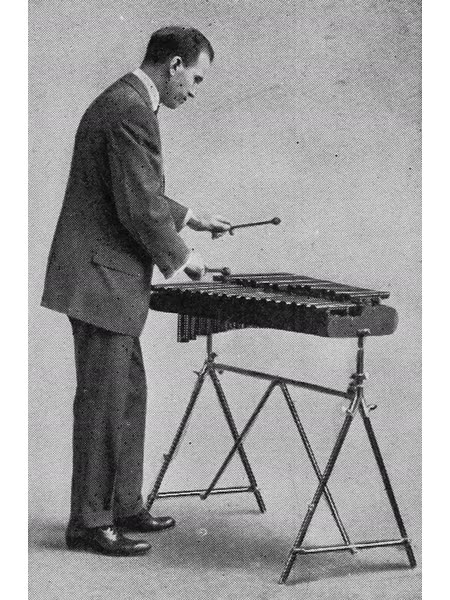
The xylophone is a set of tuned wooden bars, arranged like the keys of a piano and struck with hard mallets. Its name comes from the Greek for "wood sound," and its tone is bright, dry, and crisp, with notes that die away almost at once. Composers love it for rhythm, sparkle, humor, and the occasional rattle of skeleton bones.
How it works
The bars are traditionally made of rosewood, a very hard timber, though many modern instruments use synthetic materials that stand up better to heavy use and changes in temperature. Beneath each bar hangs a tube called a resonator, which amplifies its sound. The player strikes the bars with mallets that have hard heads of rubber, plastic, or wood, and because the notes are so short, rapid repeated notes and quick runs are the xylophone's specialty. Its music is written an octave lower than it sounds. In the orchestra it is played by a member of the percussion section.
Ancient roots
Instruments with wooden bars are among the oldest tuned instruments in the world. They have been played for centuries in Africa, where instruments such as the balafon of West Africa are central to music-making, and in Southeast Asia, including the gamelan orchestras of Indonesia. European versions were known by the 16th century, often as a folk or street instrument, and the modern concert xylophone developed in the late 19th and early 20th centuries. In the 1920s, xylophone virtuosos were stars of vaudeville, radio, and early recordings.
Xylophone, marimba, or glockenspiel?
The marimba, which grew from African instruments brought to Central America, also has wooden bars and resonators, but it is larger and lower, is played with softer mallets, and has a warm, mellow tone. The glockenspiel is played the same way as the xylophone, but its bars are steel, so it rings like a bell. The xylophone is the dry, woody one.
Famous xylophone moments
- Saint-Saëns - Danse macabre (1874), one of the first orchestral uses of the xylophone, rattling like dancing skeletons. He reused the tune in "Fossils" from The Carnival of the Animals.
- Bartók - Music for Strings, Percussion and Celesta, whose eerie slow movement opens with a single high xylophone note repeated faster and faster, then slower again.
- Holst - "Uranus, the Magician" from The Planets.
- Stravinsky - The Firebird, in the "Infernal Dance" of the evil sorcerer Kashchei.
- Gershwin - Porgy and Bess, whose opening bursts into life with a busy xylophone.
- Dmitry Kabalevsky - "Comedians' Galop," a breathless circus romp featuring the xylophone.
Where to start listening: Danse macabre and then "Fossils" from The Carnival of the Animals, to hear Saint-Saëns's skeletons from two angles. Then try the opening of the slow movement of Bartók's Music for Strings, Percussion and Celesta.