Composer
Steve Reich
A founder of minimalism, who built new music from tape loops, pulses, and patterns.
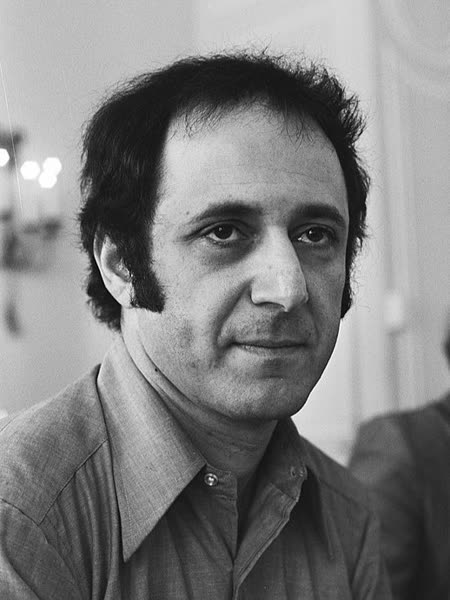
Steve Reich is one of the founders of musical minimalism and one of the most influential composers of the late 20th century. Starting with experiments on tape recorders, he discovered new ways of making music from repetition and gradual change - and his pulsing, hypnotic sound has shaped everything from concert music to electronic dance music.
Life in brief
Reich was born in New York in 1936. His parents separated when he was a baby, and as a young child he made long train journeys across America between his mother in Los Angeles and his father in New York - memories he would later turn into music. He studied philosophy at Cornell, then composition at the Juilliard School and at Mills College in California.
In San Francisco in the mid-1960s, working with tape loops of a street preacher, he noticed that two identical loops playing slightly out of step gradually drifted apart, creating constantly shifting patterns. This phasing became the basis of his early works, such as It's Gonna Rain (1965), and he soon transferred the idea to live performers. In 1966 he founded his own ensemble, Steve Reich and Musicians.
In 1970 he studied drumming in Ghana, and later Balinese gamelan and Hebrew cantillation, all of which fed into his music. Music for 18 Musicians (1976) brought him wide recognition, and he went on to write works for the Kronos Quartet, the guitarist Pat Metheny, and many orchestras. He won the Pulitzer Prize for Music in 2009, and in October 2026 he celebrated his 90th birthday with a new large ensemble work.
Music and style
Reich's music is built on a steady pulse and short repeating patterns that change gradually, so that listeners can hear the process unfolding. Beyond phasing, he builds pieces from interlocking rhythms, slowly shifting harmonies, and, in later works, recorded speech, whose natural melody he turns into instrumental lines. His music is meticulously organized, but its effect is often joyful, propulsive, and deeply physical.
Key works
- Music for 18 Musicians (1976) - an hour of shimmering, pulsing music for pianos, mallet percussion, strings, clarinets, and voices.
- Clapping Music (1972) - two performers, one clapped pattern, and nothing else.
- Drumming (1971) - a long work for percussion, inspired by his studies in Ghana.
- Different Trains (1988) - for string quartet and recorded voices, contrasting his childhood train journeys in America with the trains that carried Jews to the Nazi death camps.
- Electric Counterpoint (1987) - for guitar, written for Pat Metheny.
- Tehillim (1981) - settings of Hebrew psalms for voices and ensemble.
Legacy
Reich's influence reaches far beyond classical music: electronic musicians and rock bands have cited and sampled his work, and his ideas about repetition and process changed how composers think about time in music. Alongside Philip Glass, he is one of the defining figures of American music since the 1960s.
Where to start listening: Clapping Music shows his phasing idea in four minutes. Then try the opening of Music for 18 Musicians, and Different Trains.