Instrument
Lute
The pear-shaped plucked instrument that was the guitar of the Renaissance.
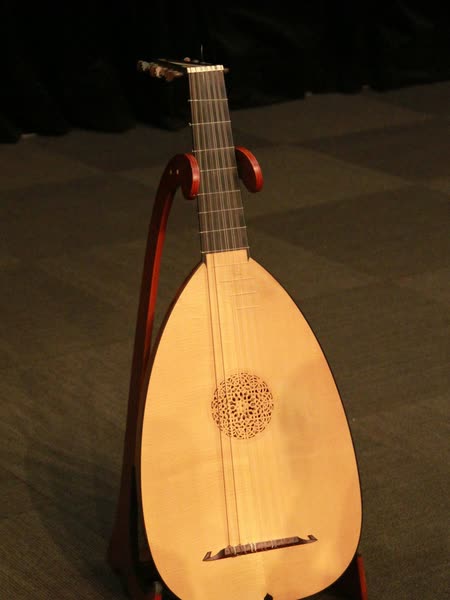
The lute is a plucked string instrument with a rounded, pear-shaped body and a neck whose pegbox bends sharply backward. For about two centuries, from the late 15th to the late 17th century, it was the most popular instrument in Europe: played by amateurs and professionals, at court and at home, for solo music, songs, and dances. Its soft, intimate, silvery sound is the voice of the Renaissance.
How it's built and played
The lute's deep, round back is built from thin strips of wood, called ribs, bent and glued together, and its flat wooden soundboard is pierced by an intricately carved rose soundhole. Its strings, traditionally made of gut, are usually arranged in pairs called courses, tuned in unison or octaves; a Renaissance lute typically had six courses, and later lutes many more. The player plucks the strings with the fingertips and presses them against frets of gut tied around the neck.
Lute music was usually written in tablature, a system that shows not the notes themselves but which string to pluck and which fret to press - an early cousin of the guitar tablature used today.
From the oud to the Renaissance
The lute descends from the oud, the classic instrument of Arab music, which reached Europe through Moorish Spain and contacts with the Islamic world in the Middle Ages. Its very name comes from the Arabic al-ʿūd. Medieval players used a plectrum, but around 1500 lutenists began plucking with their fingers, which allowed them to play several lines of music at once, and the lute became a solo instrument of great expressive range.
The lute in its golden age
The Italian Francesco da Milano was the most celebrated lutenist of the 16th century, and in England the melancholy genius John Dowland (1563–1626) wrote exquisite solos and songs for voice and lute, such as "Flow, my tears." In the Baroque era, larger lutes with extra bass strings, such as the theorbo, were used to accompany singers and ensembles in the basso continuo. The last great lute virtuoso was the German Silvius Leopold Weiss, a contemporary of Bach, who also wrote music for the lute.
As the guitar and keyboard instruments took over, the lute faded from use in the 18th century. It was revived in the 20th century by early-music players, and guitarists such as Julian Bream brought its music back to wide audiences.
Essential lute music
- John Dowland - "Flow, my tears" (Lachrimae) - one of the most famous songs of the Elizabethan age. See art song.
- Francesco da Milano - Fantasias - flowing, contrapuntal solos. See fantasia.
- Silvius Leopold Weiss - Lute Sonatas - rich, late-Baroque masterpieces.
- Bach - Lute Suites, often played today on the guitar.
- Respighi - Ancient Airs and Dances - orchestral arrangements of Renaissance lute pieces.
Where to start listening: Dowland's "Flow, my tears" with voice and lute, then a solo fantasia by Francesco da Milano. See also the classical guitar, the lute's modern cousin.