Instrument
Double Bass
The largest and lowest-pitched of the bowed strings.
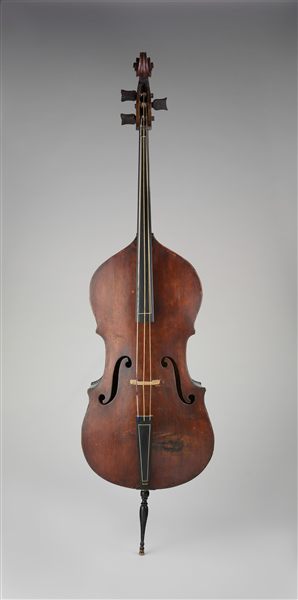
The double bass is the largest and lowest member of the string family, so large that players typically stand or perch on a tall stool to play it, rather than sitting the way violinists and violists do. Its shape also differs subtly from its smaller relatives
- sloped shoulders rather than rounded ones, a holdover from its partial ancestry in the viol family rather than the violin family alone.
In the orchestra, the double bass usually reinforces the harmonic foundation, often doubling the cello line an octave lower, providing the low-frequency weight underneath the rest of the string section. It's less frequently given prominent melodic material than the higher strings, though composers occasionally spotlight it for specific dramatic or comedic effect precisely because it's unexpected.
Beyond the orchestra, the double bass is also central to jazz and many other genres, played pizzicato (plucked) far more often outside classical music than within it.
One more legacy of its viol ancestry: unlike the rest of the string family, which is tuned in fifths, the double bass is tuned in fourths (typically E-A-D-G). The wider stretch a fifth would demand between fingers is far less practical on an instrument this large, so the narrower fourths make basic fingering patterns physically manageable. Players also differ in bow technique more than other string sections do, using either a French-style bow held like a violinist's or a German-style bow gripped underhand, a distinction that survives from different regional playing traditions.
Where to start listening: the opening of the third movement of Mahler's Symphony No. 1 famously gives the double bass a rare, exposed solo melody.