Composer
Henryk Górecki
The Polish modernist whose slow, sorrowful symphony sold over a million records.
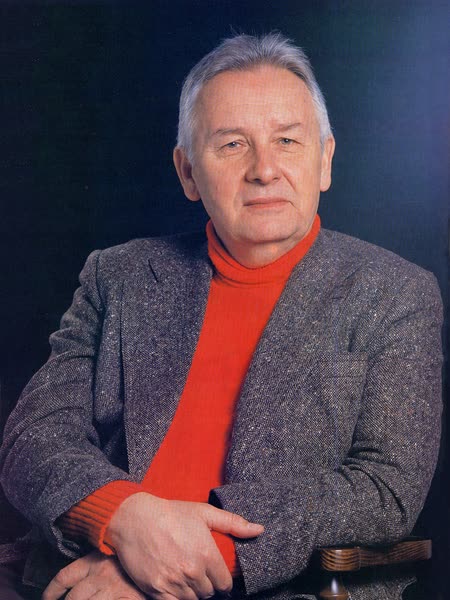
Henryk Górecki was a Polish composer who, late in his career, became one of the most unlikely best-sellers in the history of classical music. His Third Symphony, a slow, meditative work of grief and consolation, was little known for fifteen years after it was written - and then a new recording sold more than a million copies.
Life in brief
Górecki was born in 1933 in Czernica, a village in Silesia in southern Poland. His mother died when he was two, and a childhood hip injury left him with lifelong health problems. He trained as a primary school teacher before studying composition in Katowice, the industrial city that would be his home for the rest of his life.
In the late 1950s and 1960s he was one of the leading figures of the Polish avant-garde, writing harsh, explosive, experimental music. Gradually his style changed: he turned to slow, simple, intensely repetitive music, rooted in Polish folk song and Catholic chant. He taught at the music academy in Katowice and was its rector in the 1970s, resigning in protest against the Communist authorities. A devout Catholic, he wrote several works linked to Pope John Paul II.
In 1992 a recording of his Third Symphony, sung by the American soprano Dawn Upshaw, became an international phenomenon, topping classical charts and crossing into the British pop album charts. Górecki, a private man, was bemused by the sudden fame. He died in Katowice in 2010.
Music and style
Górecki's mature music is slow, spacious, and deeply spiritual, built from simple chords and modal melodies repeated and gradually transformed. It is often linked with the "holy minimalism" of Arvo Pärt and John Tavener, though Górecki rejected labels. Beneath its calm surface lies a strong sense of Polish history and suffering, and moments of sudden, overwhelming power.
Key works
- Symphony No. 3, "Symphony of Sorrowful Songs" (1976) - three slow movements for soprano and orchestra, each about a mother and child: a 15th- century lament of Mary at the cross, a prayer written on the wall of a Gestapo cell by an eighteen-year-old girl in 1944, and a folk song of a mother mourning her son. See symphony.
- Totus Tuus (1987) - a radiant unaccompanied choral piece written for a visit by Pope John Paul II to Poland. See choral music.
- Beatus Vir (1979) - a psalm setting commissioned by the future pope when he was Archbishop of Kraków.
- String Quartet No. 1, "Already It Is Dusk" (1988) - written for the Kronos Quartet. See string quartet.
- Harpsichord Concerto (1980) - a short, hammering, exhilarating work, quite unlike his slow music. See harpsichord.
Legacy
The success of Górecki's Third Symphony showed that new classical music could reach a vast audience, and it remains one of the best-selling classical recordings of modern times. See also minimalism and the contemporary era.
Where to start listening: the second movement of the Third Symphony - ten minutes of heartbreaking beauty. Then try Totus Tuus.