Instrument
Trombone
The only common orchestral instrument that changes pitch with a sliding tube instead of valves.
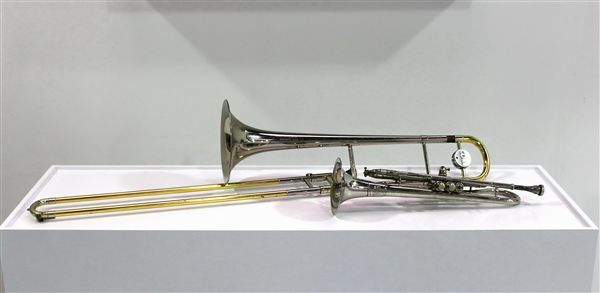
The trombone is the brass family's outlier: instead of valves rerouting air through extra tubing, a trombonist changes pitch by physically sliding a U-shaped section of tube in and out, lengthening or shortening the air column directly. That mechanism gives the trombone a genuinely continuous glide between pitches (a glissando) that valved brass instruments like the trumpet can't reproduce cleanly.
Historically, the trombone kept a strong association with sacred and ceremonial music (it was a mainstay of church and civic brass ensembles well before becoming a regular orchestral fixture), and composers have long used its combination of power and dignity for solemn or triumphant passages alike. Its design changed remarkably little over that long history: Renaissance-era trombones (then called sackbuts) already used the same telescoping slide principle as the modern instrument, and composers like Giovanni Gabrieli were writing multi-choir brass music featuring them in Venice well before the trombone had any regular place in an opera or symphony orchestra.
The standard orchestral section uses two tenor trombones and one bass trombone, the latter built with a wider bore and extra tubing to reach comfortably down into the lowest register alongside the tuba. Because the slide can stop at any point along its length rather than jumping between fixed valve positions, a skilled player can also produce smooth pitch bends unavailable to valved brass - a technique composers have exploited for both comic sliding effects and eerie, unsettling ones.
Where to start listening: the trombone-led "Tuba mirum" of Mozart's Requiem, and the trombone-heavy "Dies irae" of Verdi's, show the instrument's weightier, more solemn character. The famous trombone solo in the third movement of Mahler's Symphony No. 3 shows its lyrical, almost vocal side instead.