Instrument
French Horn
The brass family's mellowest voice, and its bridge to the woodwinds.
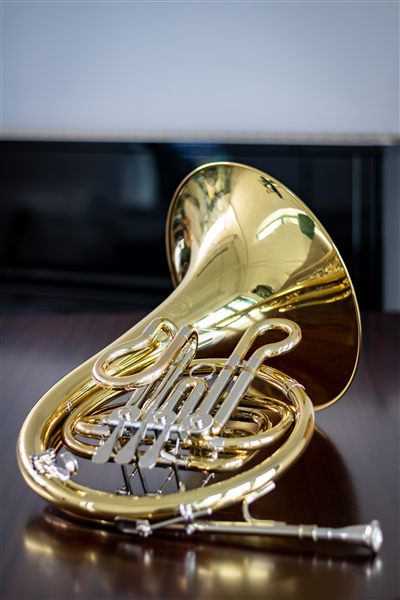
The French horn descends directly from the hunting horn, and still carries some of that ancestry in its long, tightly coiled tubing (often well over 12 feet, wound into a compact circular shape) and in its characteristically mellow, rounded tone - noticeably softer-edged than the trumpet or trombone elsewhere in the brass family.
That blending tone is exactly why composers frequently use the horn as a bridge between brass and woodwinds, seating it near the woodwind section in many orchestras and writing horn parts that combine naturally with both groups. The instrument is also notoriously difficult to play accurately - its very long tubing packs many available pitches close together in the overtone series, leaving little margin for error in lip control.
For most of its orchestral history the horn had no valves at all: players changed pitch largely by inserting different lengths of tubing (crooks) and by "hand-stopping," partially covering the bell with the right hand to bend the pitch and alter the tone. Valves, added in the 19th century, finally gave the horn a full chromatic range without constant retuning, though many players still keep a hand resting in the bell today, partly out of habit and partly because it still shapes the tone. Mozart wrote four horn concertos for his friend Joseph Leutgeb, an early sign of how far the instrument's expressive range had already come even before valves existed, and Richard Strauss, whose father was a professional horn player, later gave the instrument some of its most prominent orchestral and concerto writing.
Where to start listening: the horn solo that opens the second movement of Tchaikovsky's Symphony No. 5 shows the instrument's warm, lyrical solo voice. Mozart's Horn Concerto No. 4 is a good way to hear the instrument as a soloist rather than an ensemble voice.