Composer
Giovanni Pierluigi da Palestrina
The Roman master whose serene polyphony became the model of sacred music.
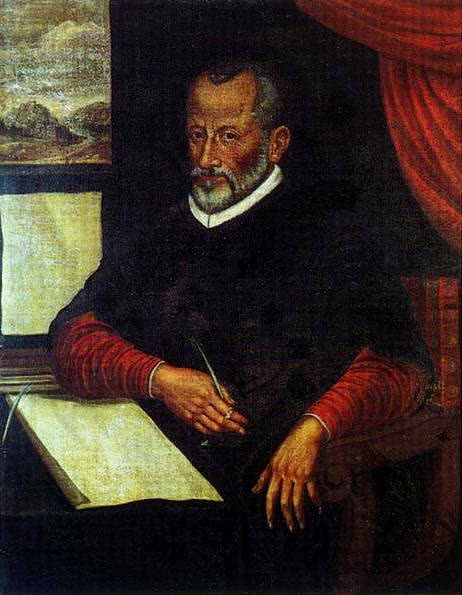
Giovanni Pierluigi da Palestrina spent his whole career writing music for the churches of Rome, and his name has become almost synonymous with Renaissance sacred polyphony. His music is smooth, serene, and perfectly balanced - so much so that for centuries afterward it was taught as the textbook model of how voices should move together.
Life in brief
He was born around 1525 in the small town of Palestrina, near Rome, from which he takes his name. He sang as a choirboy at the basilica of Santa Maria Maggiore in Rome, then became organist in his home town, where the local bishop - later Pope Julius III - took notice of him. In 1551 the new pope made him director of the Cappella Giulia, the choir of St Peter's Basilica.
His career had setbacks. Appointed to the pope's own Sistine Chapel choir in 1555, he was dismissed the same year by a stricter pope because he was a married man. He went on to direct the music at the basilicas of St John Lateran and Santa Maria Maggiore, and in 1571 returned to the Cappella Giulia, where he stayed until his death in 1594.
His private life was marked by loss: his first wife and two of his sons died in outbreaks of disease. After his wife's death in 1580 he briefly considered becoming a priest, but instead married a wealthy widow and helped run her fur business - while continuing to compose prolifically.
Music and style
Palestrina's music flows in long, arching lines, each voice moving mostly by step, with dissonances carefully prepared and gently resolved. The result is calm and luminous, with the words of the text kept clear - an important concern for the Catholic Church in the years of the Council of Trent, which debated whether elaborate polyphony obscured sacred texts.
A famous legend claims that his Missa Papae Marcelli convinced the Council not to ban polyphony altogether, "saving" church music. Historians now regard the story as a myth, but the Mass does show exactly the clarity the Council wanted, and the legend helped make Palestrina a symbol of ideal sacred music.
Key works
- Missa Papae Marcelli (published 1567) - his most famous Mass, named for Pope Marcellus II.
- Sicut cervus - a short, beautiful motet on Psalm 42: "As the deer longs for the water-brooks."
- Stabat Mater - a radiant setting for double choir.
- Missa Assumpta est Maria - a joyful Mass for six voices.
- Motets on the Song of Songs (1584) - sensuous settings of the biblical love poetry.
He wrote over a hundred Masses and hundreds of motets, as well as madrigals.
Legacy
In 1725 the Austrian theorist Johann Joseph Fux based his textbook on counterpoint, Gradus ad Parnassum, on Palestrina's style. Haydn, Mozart, and Beethoven all studied from it, and versions of its method are still taught today. In 1917 the German composer Hans Pfitzner even wrote an opera, Palestrina, about the legend of the Missa Papae Marcelli.
Where to start listening: Sicut cervus is three or four minutes of pure serenity and a perfect first taste. Then try the Kyrie of the Missa Papae Marcelli, sung by a cathedral choir or a small professional ensemble.